
By Michael Phillips | VABayNews
A fatal shooting in Reston has ignited renewed debate over public safety, prosecutorial discretion, and cooperation with federal immigration enforcement in Northern Virginia—just miles from Washington, D.C.
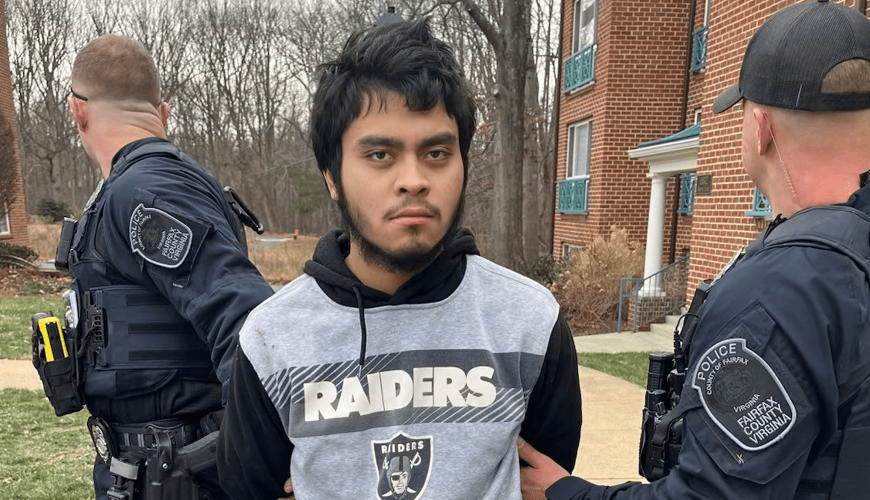
On December 17, 2025, Fairfax County Police Department responded to a shooting at a home in Reston, where 40-year-old Marvin Ernesto Morales was found dead from gunshot wounds. Police arrested his roommate, 23-year-old Marvin Fernando Morales-Ortez, after a multi-hour manhunt and charged him with second-degree murder and use of a firearm in a felony.
The arrest came one day after Morales-Ortez was released from the Fairfax County Adult Detention Center—a decision that has drawn sharp criticism from federal officials and raised questions about local policy choices.
A Release That Sparked National Attention
Morales-Ortez, a Salvadoran national in the United States illegally according to U.S. Immigration and Customs Enforcement (ICE), had been jailed since September 2025 on charges of felony malicious wounding and brandishing a firearm. On December 16, those charges were nolle prossed (dropped with the option to refile) by the Fairfax County Commonwealth’s Attorney’s Office, citing insufficient evidence after the alleged victim left the country and declined to cooperate.
ICE had lodged an immigration detainer requesting the county hold Morales-Ortez for transfer to federal custody. The Fairfax County Sheriff’s Office declined to honor the detainer without a judicial warrant and released him. ICE and U.S. Department of Homeland Security later condemned the decision, arguing that cooperation would have prevented the subsequent homicide.
A Pattern of Charges—and Dismissals
Court records show Morales-Ortez faced at least seven charges in Fairfax County since 2020, including assaults, disorderly conduct, brandishing a firearm, and larceny. With the exception of a petit larceny conviction (a $300 fine, unpaid), most cases were dismissed or dropped.
One earlier case—a first-degree murder charge from 2019—was dismissed in 2021 after prosecutors determined Morales-Ortez was not the perpetrator; another individual was later convicted federally. While some reports reference alleged gang associations, there is no conviction for gang activity, a distinction often blurred in heated public debate.
Sanctuary Status—By Name or by Practice?
Fairfax County is not formally designated a “sanctuary county” by its Board of Supervisors. County leaders say they comply with criminal law while limiting voluntary enforcement of civil immigration matters. In practice, however, critics argue that policies requiring a judicial warrant to honor ICE detainers and restricting immigration inquiries function as sanctuary-like measures.
According to the Center for Immigration Studies, Fairfax ranks among jurisdictions with the highest number of declined ICE detainers in recent years. Federal officials say that gap between formal labels and day-to-day practice has real-world consequences.
Prosecutorial Discretion at the Center
Commonwealth’s Attorney Steve Descano has defended his office’s decisions as evidence-based, emphasizing constitutional protections and the difficulty of prosecuting cases without cooperative witnesses. Critics counter that repeated dismissals in serious cases—combined with limited cooperation with ICE—create a revolving door that endangers the public.
This tension reflects a broader national debate: How should local prosecutors balance due process, immigration status, and community safety—especially when federal authorities request custody?
Mental Health and Missed Interventions
After Morales-Ortez’s December 16 release, a clinician obtained an Emergency Custody Order (ECO) for mental-health evaluation. The order expired after eight hours when police could not locate him. The following day, the shooting occurred.
The episode underscores another concern often lost in political arguments: whether current systems adequately address mental-health risks for individuals with violent histories who are released back into the community.
What This Case Raises for Virginians
For center-right voters and concerned citizens, the Reston homicide poses difficult but necessary questions:
- Should counties be required to honor ICE detainers when individuals face serious violent charges?
- Are repeated nolle prosequi decisions in felony cases undermining deterrence and accountability?
- Does refusing federal cooperation—while claiming compliance—leave communities exposed?
- And how can mental-health interventions be strengthened to prevent rapid reoffending?
As Morales-Ortez awaits a preliminary hearing in March 2026, the policy debate is unlikely to fade. What is clear is that public safety, prosecutorial judgment, and immigration enforcement are no longer abstract issues in Northern Virginia—they are matters with life-and-death consequences.
 Virginia Bay News