
By Michael Phillips | Virginia Bay News
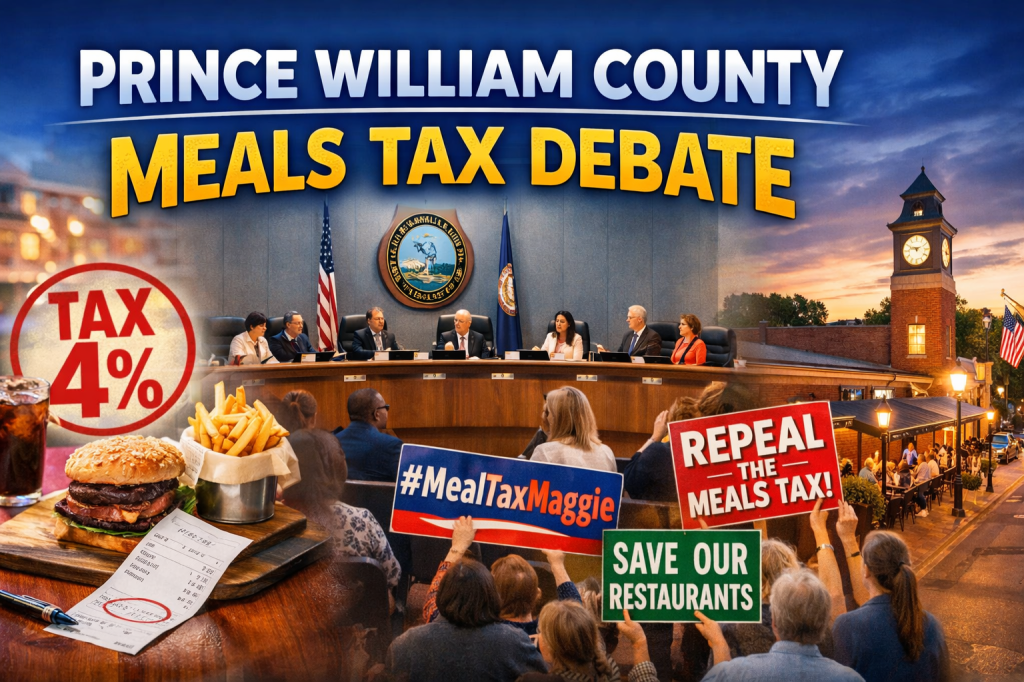
PRINCE WILLIAM COUNTY, Va. — More than three years after its controversial rollout, Prince William County’s Food and Beverage Tax—better known as the “meals tax”—remains a flashpoint in Northern Virginia’s ongoing debate over taxes, affordability, and economic growth.
The tax, set at 4% since July 1, 2022, applies to prepared foods and beverages sold by restaurants, caterers, food trucks, and grocery store delis offering ready-to-eat items. When combined with Virginia’s state sales tax, diners often pay close to 10% in total taxes on a meal.
Beginning January 1, 2026, the rate will drop to 3% following a July 2025 vote by the Prince William County Board of Supervisors. While county leaders describe the reduction as meaningful relief, critics argue it falls short—and that the original tax should never have been imposed without voter approval.
A Tax Born of the Pandemic Era
The meals tax was adopted during the FY2023 budget process under a Democratic-majority board led at the time by Chair Ann Wheeler. Supporters argued it would generate roughly $24.5 million annually—much of it earmarked for public schools—without raising property taxes.
Opponents countered that the tax arrived at the worst possible moment: as restaurants struggled to recover from COVID-19 shutdowns, labor shortages, and soaring food costs. Republican supervisors warned it would disproportionately hit working families and small businesses operating on thin margins.
Revenue Up, Frustration Too
In practice, the tax has far exceeded early revenue projections:
- FY2023: approximately $30 million
- FY2024: nearly $45 million
- FY2025 (projected): about $42 million
Meals tax revenue now accounts for roughly 2% of the county’s general fund tax collections.
That financial success, however, has only intensified criticism from restaurant owners and industry advocates. Groups like the Virginia Restaurant Lodging & Travel Association argue that higher prices have reduced customer traffic, increased consumer frustration, and forced restaurants to absorb losses or risk negative reviews.
Several owners interviewed by WJLA in earlier reporting said sales dropped sharply after the tax took effect, with some citing declines of 20% or more in the months following implementation.
Political Backlash and #MealTaxMaggie
The meals tax became a central issue in the county’s 2023 and 2024 elections, spawning petitions, rallies, and the social-media campaign #mealtaxmaggie—aimed at supervisors seen as its strongest backers.
Coles District Supervisor Yesli Vega, one of the board’s most vocal critics, has repeatedly called the tax “regressive,” arguing it hits lower-income families hardest while discouraging local dining. Vega supported the 2025 rate reduction but continues to push for full repeal.
Democratic leaders counter that there is no evidence of widespread restaurant closures directly attributable to the tax and note that nearby jurisdictions impose similar or higher rates. Arlington County now levies a 5% meals tax, and Fairfax County is set to introduce a 4% tax in 2026, while Loudoun County continues to impose none.
A Partial Cut, an Unfinished Debate
The 1% reduction scheduled for 2026 is projected to cost the county roughly $12 million annually once fully implemented. Supporters frame it as a balanced compromise—offering some relief while preserving funding for schools and services. Critics argue the county’s revenue “overperformance” proves deeper cuts, or outright repeal, are fiscally possible.
With the Board of Supervisors still split 5–3 in favor of Democrats, full repeal remains unlikely in the near term. But as inflation pressures persist and residents continue to scrutinize local taxes, the meals tax debate shows no signs of disappearing.
For many Prince William County diners and restaurant owners, the question remains simple: if the county can afford to collect less, why keep taxing meals at all?
 Virginia Bay News