
By Michael Phillips | VABayNews
As Virginia’s 2026 General Assembly session gets underway, Senate Democrats are already facing criticism over what opponents see as an early contradiction between campaign rhetoric and governing reality.
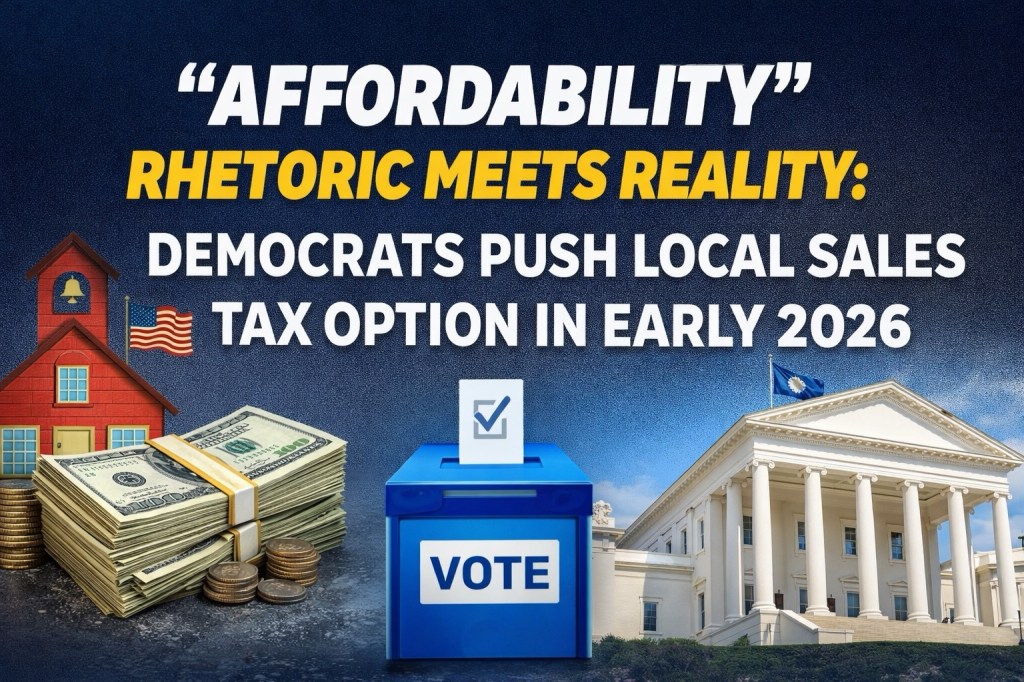
A post circulating from Northern Virginia Campaigns this week highlights Senate Bill 66 (SB66)—legislation introduced before Governor-elect Abigail Spanberger is even sworn into office—as evidence that Democrats are moving quickly toward tax increases despite running heavily on “affordability.”
What SB66 Actually Does
SB66, introduced by Sen. Jeremy S. McPike of Prince William County, authorizes every county and city in Virginia to seek voter approval for an additional local sales and use tax of up to 1%, with revenue dedicated exclusively to public school capital projects such as construction, renovations, and major infrastructure upgrades.
Supporters emphasize several guardrails:
- The tax is not automatic; it must be approved by voters in a local referendum.
- Funds are restricted to school capital needs, not operating budgets.
- It offers localities an alternative to higher property taxes.
But the bill also contains a notable change: it removes any requirement for the tax to expire, meaning a “temporary” school tax could become permanent once approved.
The legislation is currently in committee, according to the Virginia Legislative Information System.
A Local Option — With Statewide Implications
Defenders of SB66 argue that calling it a “tax hike” is misleading. Virginia’s base state sales tax remains unchanged, and any increase would be locally decided. Yet critics counter that for families already dealing with inflation, housing costs, and higher everyday expenses, an extra 1% at the register is still a tax increase—no matter how it’s labeled.
Virginia’s combined sales tax rates already range roughly from 5.3% to about 7% depending on locality. SB66 opens the door for some jurisdictions, particularly in Northern Virginia and Hampton Roads, to push those rates even higher.
From a center-right perspective, the concern is less about schools needing repairs—few dispute that—and more about process, permanence, and priorities. School construction costs have soared in recent years, often driven by administrative mandates, energy requirements, and architectural standards set at the state level. Yet SB66 focuses on generating new revenue rather than asking harder questions about cost control, procurement reform, or accountability in school construction spending.
The Affordability Gap
Spanberger’s successful gubernatorial campaign leaned heavily on cost-of-living issues, positioning Democrats as attentive to middle-class pressures. The timing of SB66, even if reintroduced from prior sessions, complicates that message.
While Democrats can fairly note that similar proposals have stalled for years under divided government, unified control of the House, Senate, and governor’s office now changes the political calculus. Measures that once faced veto threats or House resistance suddenly have a clearer path forward.
The Bigger Question for Voters
At its core, SB66 raises a familiar Virginia question: Should long-term public infrastructure be funded through consumption taxes that hit everyone equally, or through reforms that rein in costs before asking taxpayers for more?
Because the bill relies on local referendums, voters will ultimately decide. But once the authority exists—and especially once expiration dates disappear—local officials may find it easier to ask for new revenue than to make tough budget trade-offs.
For a party campaigning on affordability, that tension is unlikely to go away as the 2026 session unfolds.
Support Independent Journalism
Virginia Bay News is part of the Bay News Media Network — a growing group of independent, reader-supported newsrooms covering government accountability, courts, public safety, and institutional failures across the country.
Support independent journalism that isn’t funded by political parties, corporations, or government agencies
Submit tips or documents securely — if you see something wrong, we want to know
Independent reporting only works when readers stay engaged. Your attention, tips, and support help keep these stories alive.
 Virginia Bay News