
By Michael Phillips | VABayNews
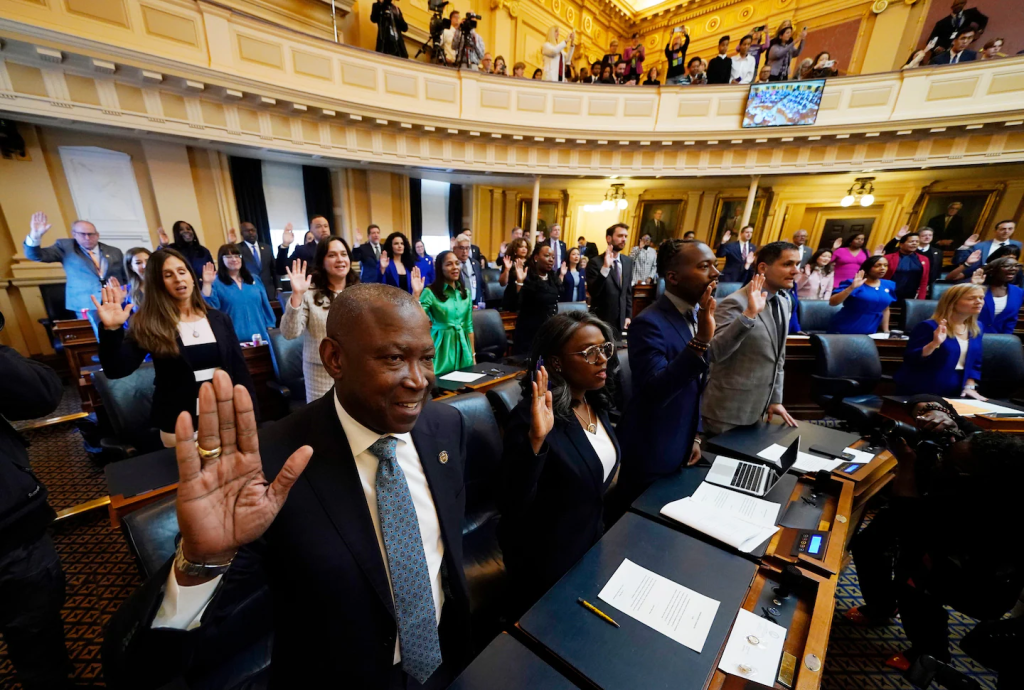
On January 14, 2026—the opening day of the Virginia General Assembly—Democrats used their newly solidified trifecta control of state government to advance four proposed constitutional amendments through the House of Delegates, setting the tone for what is expected to be one of the most ideologically charged sessions in recent memory.
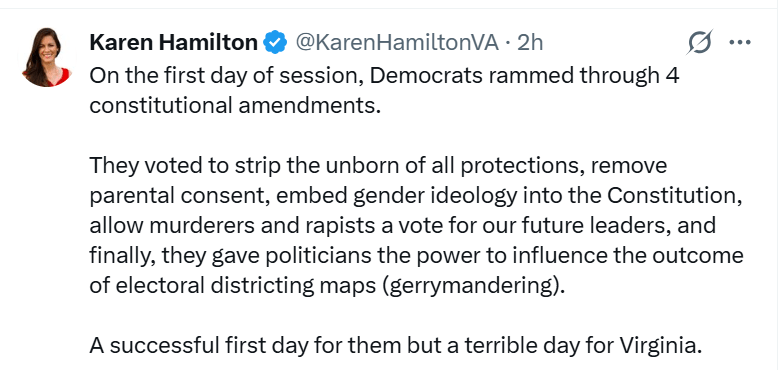
The move prompted immediate criticism from Republicans, including freshman Delegate Karen Hamilton, who was sworn in the same day to represent parts of Culpeper, Greene, Madison, and Orange counties. In a post on X, Hamilton accused Democrats of “ramming through” amendments that she said undermine protections for the unborn, weaken parental rights, politicize elections, and alter long-standing constitutional norms.
A Fast Start With Big Stakes
The four measures advanced on opening day are not new proposals. Each passed the General Assembly in 2025, satisfying the first of Virginia’s two required legislative approvals for constitutional amendments. Passage again in 2026 would send them to voters for ratification, most likely in November.
Democrats argue the timing reflects voter mandates from the 2025 elections. Republicans counter that moving sweeping constitutional changes on day one—before budget negotiations or core governance issues—signals misplaced priorities.
The Four Amendments at Issue
1. Reproductive Freedom Amendment (HJ1)
This proposal would add a “fundamental right to reproductive freedom” to Virginia’s Constitution, covering contraception, abortion, miscarriage management, and fertility treatments such as IVF. It allows regulation of late-term abortions but bars bans deemed medically necessary.
Republicans argue the language is overly broad and could override existing parental consent laws for minors. Supporters say it protects Virginians from future restrictions driven by national political shifts.
2. Automatic Restoration of Voting Rights (HJ2)
The amendment would automatically restore voting rights to individuals with felony convictions once they complete incarceration, probation, and parole—eliminating the current system of case-by-case gubernatorial approval.
Critics frame the change as allowing individuals convicted of violent crimes to vote, while Democrats say it standardizes and depoliticizes a process they view as arbitrary.
3. Marriage Amendment (HJ9)
This would repeal Virginia’s 2006 constitutional ban on same-sex marriage, a provision already unenforceable under federal law since Obergefell v. Hodges (2015).
Democrats argue the amendment simply aligns the Constitution with existing law. Some conservatives warn it could open the door to broader redefinitions of marriage and family policy.
4. Mid-Decade Congressional Redistricting (HJ4)
Perhaps the most controversial measure, this amendment would temporarily allow the General Assembly to redraw congressional districts outside the normal 10-year census cycle—but only if another state does so first.
Democrats describe it as a defensive tool against aggressive partisan gerrymandering elsewhere. Republicans call it an explicit invitation for politicians to manipulate maps for partisan gain, undermining Virginia’s independent redistricting reforms.
Partisan Lines Clearly Drawn
House votes largely followed party lines, with margins in the low-to-mid 60s for passage. Senate approval was expected quickly, given Democratic control there as well.
Hamilton’s comments reflect a broader Republican argument that Democrats are using constitutional amendments not as safeguards of consensus values, but as vehicles for locking in progressive policies beyond the reach of future legislatures.
Democrats, meanwhile, argue the amendments protect individual rights, modernize outdated provisions, and respond to national political pressures that could affect Virginia residents.
What Comes Next
If the Senate approves the measures, Virginians will have the final say at the ballot box—most likely in November 2026. Until then, these amendments will dominate campaign messaging, fundraising appeals, and legislative debate throughout the year.
For now, opening day has made one thing clear: the 2026 session will not be about incremental change, but about defining Virginia’s constitutional future—one highly contested amendment at a time.
Support Independent Journalism
Virginia Bay News is part of the Bay News Media Network — a growing group of independent, reader-supported newsrooms covering government accountability, courts, public safety, and institutional failures across the country.
Support independent journalism that isn’t funded by political parties, corporations, or government agencies
Submit tips or documents securely — if you see something wrong, we want to know
Independent reporting only works when readers stay engaged. Your attention, tips, and support help keep these stories alive.
 Virginia Bay News