
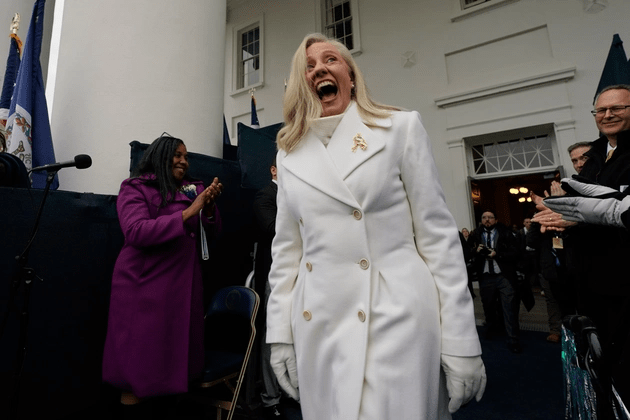
Richmond, Va. — On January 17, 2026, Abigail Spanberger was sworn in as Virginia’s 75th governor — and the first woman to hold the office — marking a decisive shift in state leadership after her commanding victory in the November 2025 election.
Spanberger, a Democrat and former U.S. Representative with a background as a CIA officer, defeated Republican nominee Winsome Earle-Sears by a wide margin, roughly 56–58 percent to 42–43 percent. Her win returned the governor’s mansion to Democratic control and completed a party trifecta in Richmond, with Democrats already holding majorities in both chambers of the General Assembly.
Within hours of taking office at the Virginia State Capitol, Spanberger signed a slate of executive orders outlining what she described as a pragmatic “Day One” agenda focused on affordability, education, and state preparedness. But one order, in particular, immediately drew sharp political reactions: the rescission of former Governor Glenn Youngkin’s Executive Order 47.
Reversing Youngkin’s Immigration Enforcement Push
Youngkin’s February 2025 order directed state agencies — including the Virginia State Police and the Department of Corrections — to cooperate more closely with Immigration and Customs Enforcement through so-called 287(g) agreements. These agreements allow state and local officers to assist with certain federal immigration enforcement tasks, such as sharing inmate information and honoring ICE detainers, with a stated focus on individuals accused or convicted of serious crimes.
Spanberger’s executive action ends that mandate. Her administration argues that immigration enforcement is a federal responsibility and that compelling state law enforcement to assist diverts resources from core public safety functions like investigating crimes, staffing jails, and building trust with local communities.
During the campaign, Spanberger repeatedly criticized Youngkin’s approach as inefficient and counterproductive. Supporters of the repeal point to data showing that a significant share of detainees held in Virginia ICE facilities had no criminal convictions, raising concerns that the policy extended well beyond targeting violent offenders.
Elections Have Consequences
From a center-right perspective, the move underscores a basic political reality: elections matter. Spanberger was explicit during the campaign that she intended to roll back Youngkin’s immigration policies, and voters — particularly in Northern Virginia and suburban regions — delivered her a clear mandate.
That said, the decision has reignited long-running debates over public safety and immigration. Conservative commentators and Republican officials have warned that ending mandatory cooperation with ICE risks turning Virginia into a de facto “sanctuary” state, potentially allowing dangerous individuals to slip through the cracks. Some have framed the move as prioritizing ideology over safety.
Spanberger and her allies reject that characterization, arguing that nothing in the order prevents cooperation with federal authorities when warranted and that local jurisdictions retain discretion. They also contend that community trust in law enforcement is itself a public safety issue — one they believe was undermined by Youngkin’s directive.
Setting the Tone for a New Administration
The immigration order was just one element of a broader Day One rollout. Spanberger also signed directives aimed at reducing regulatory costs, addressing housing affordability, strengthening public education, and preparing Virginia for potential federal funding disruptions. In her inaugural remarks, she emphasized unity and practical governance, invoking Virginia’s history while promising to focus on results rather than rhetoric.
For Republicans, the challenge now is less about relitigating the 2025 election and more about defining a clear contrast heading into future statewide races — particularly if concerns about crime, immigration, or federal overreach gain traction with voters.
For now, Spanberger’s first hours in office have made one thing clear: Virginia has entered a new political chapter, and the policy pendulum has swung decisively away from the Youngkin era. Whether that shift delivers the outcomes voters expect will be tested in the months and years ahead.
Support Independent Journalism
Virginia Bay News is part of the Bay News Media Network — a growing group of independent, reader-supported newsrooms covering government accountability, courts, public safety, and institutional failures across the country.
Support independent journalism that isn’t funded by political parties, corporations, or government agencies
Submit tips or documents securely — if you see something wrong, we want to know
Independent reporting only works when readers stay engaged. Your attention, tips, and support help keep these stories alive.
 Virginia Bay News