
By VABayNews Staff
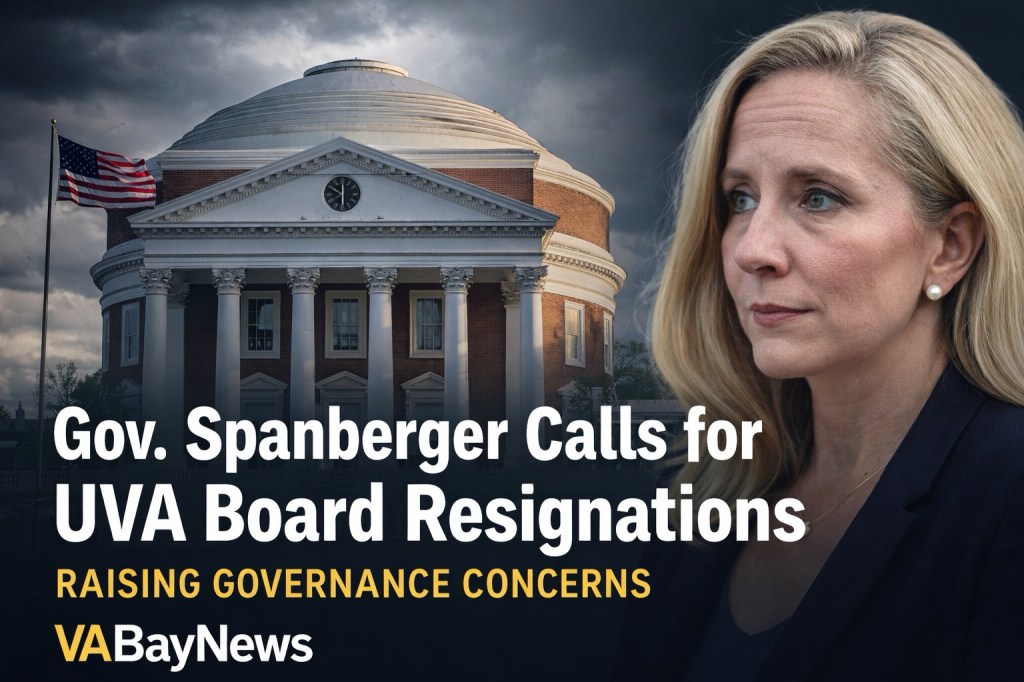
As Virginia transitions into new leadership, early moves by Governor-elect Abigail Spanberger are already stirring controversy—particularly around the future governance of the University of Virginia.
According to multiple reports and public statements circulating this week, Spanberger has asked several members of UVA’s Board of Visitors—appointees of outgoing Republican Governor Glenn Youngkin—to resign. Those reportedly asked to step down include board chair Rachel Sheridan and prominent donor Paul Manning.
The new governor has not publicly explained the rationale behind the request.
A Break With Tradition?
While governors in Virginia have long exercised influence over public university boards through appointments, it is far less common for an incoming administration to actively seek the resignation of sitting board members—particularly before taking office, and without citing misconduct or cause.
Critics argue that this move risks politicizing one of the Commonwealth’s most prestigious academic institutions and undermining the long-standing principle that university governance should remain insulated from day-to-day partisan power struggles.
“This sets a troubling precedent,” said one higher-education observer familiar with UVA governance. “Boards are meant to provide continuity and institutional stability—not serve at the pleasure of whichever party just won the last election.”
Fallout From Last Year’s Leadership Turmoil
The backdrop to the dispute is UVA’s recent leadership upheaval. Last year, the university’s former president resigned following intense pressure amid a Justice Department investigation—an episode some critics described as an unusually aggressive federal intervention into university affairs.
After Spanberger’s election in November, she reportedly urged the Board of Visitors to delay naming a permanent replacement. The board declined and proceeded with appointing a new president.
Now, reports suggest that Spanberger’s transition team is also seeking to remove the newly appointed president, arguing that her allies were not involved in the selection process.
That position has raised eyebrows across the political spectrum.
Governance or Takeover?
Supporters of the new governor frame the effort as a necessary reset, arguing that the board no longer reflects Virginia’s political leadership or priorities. But opponents see something more concerning: an attempt to exert ideological control over an independent public institution.
A social-media post from a Charlottesville political account characterized the situation bluntly: “Now comes Democrat takeover of UVA,” warning that both board members and senior leadership could be swept aside.
While such language may overstate the case, the underlying concern resonates with many center-right voters: whether public universities are becoming increasingly subject to partisan capture rather than merit-based governance.
Campaign Rhetoric vs. Governing Reality
Spanberger campaigned as a consensus-builder, frequently emphasizing her ability to “work across the aisle.” For some observers, the aggressive posture toward UVA’s board appears at odds with that message.
Even some moderates have expressed unease—not over the legality of the move, but over its tone and timing.
Virginia’s public universities serve students, families, researchers, and employers across the Commonwealth. Their credibility depends on stability, transparency, and trust—qualities that can erode quickly if leadership changes are perceived as politically motivated.
What Comes Next
As of now, it remains unclear whether the board members in question will comply with the resignation requests, or whether the issue will escalate into a public standoff as Spanberger formally takes office.
What is clear is that the episode will test how Virginia balances democratic accountability with institutional independence—and whether its flagship university can remain above the political fray in an increasingly polarized climate.
For many Virginians, the concern is not who controls UVA, but whether any administration—Republican or Democrat—should.
Support Independent Journalism
Virginia Bay News is part of the Bay News Media Network — a growing group of independent, reader-supported newsrooms covering government accountability, courts, public safety, and institutional failures across the country.
Support independent journalism that isn’t funded by political parties, corporations, or government agencies
Submit tips or documents securely — if you see something wrong, we want to know
Independent reporting only works when readers stay engaged. Your attention, tips, and support help keep these stories alive.
 Virginia Bay News