
By VABayNews Staff
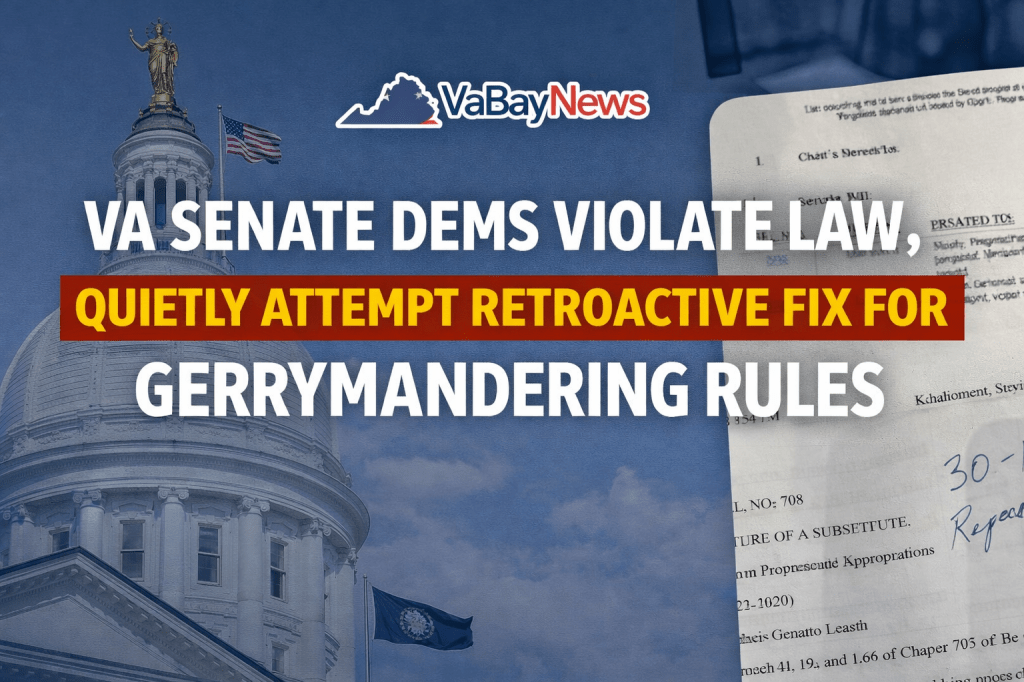
Virginia Senate Democrats have quietly conceded that they violated state law while advancing a controversial gerrymandering-related constitutional amendment—then responded by attempting to retroactively repeal the very law they failed to follow.
The admission, first reported by Mark Obenshain, centers on a procedural failure to provide proper public notice before advancing a constitutional amendment tied to redistricting. Under Virginia law, constitutional amendments require strict notice and transparency rules to ensure voters and lawmakers are fully informed before major structural changes are considered.
Instead of restarting the process or acknowledging the error publicly, Senate Democrats moved late in the day to repeal the “problematic” notice requirement—retroactively, and without prior public notice.
A Quiet Admission, A Loud Implication
According to Obenshain’s reporting, Senate Democrats conceded internally that they failed to meet statutory notice requirements. That acknowledgment alone is significant: it effectively confirms that the legislature did not follow the law while pushing an amendment that would reshape how Virginia’s political maps are drawn.
Even more troubling is the response. Rather than pause proceedings or allow public scrutiny, Democratic leaders reportedly pushed a repeal measure in the afternoon, with no advance notice to the public—ironically repeating the very transparency failure at issue.
This raises serious questions about legislative accountability and whether procedural safeguards are being treated as optional when politically inconvenient.
Retroactive Lawmaking and the Rule of Law
Retroactive legislation is not inherently unconstitutional, but it is widely viewed as a red flag in democratic governance—especially when used to shield lawmakers from their own procedural missteps.
By attempting to repeal the notice requirement retroactively, critics argue that Senate Democrats are effectively rewriting the rules after the fact to legitimize an action that would otherwise be unlawful. That approach undermines the purpose of notice laws, which exist precisely to prevent rushed or opaque changes to the state’s constitutional framework.
At a minimum, it creates the appearance that lawmakers believe compliance is secondary to outcomes.
Gerrymandering by Process, Not Just Map
The debate over gerrymandering is often framed around district lines and partisan advantage. But process matters just as much as outcome.
If constitutional amendments can be advanced without proper notice—and then insulated from challenge by retroactive legislative fixes—the public loses one of its few meaningful checks on the redistricting process.
Transparency is not a partisan luxury. It is a prerequisite for legitimacy.
Why This Matters
Virginia voters were promised a fairer, more transparent redistricting system. That promise rings hollow when the process itself appears rushed, opaque, and retroactively rewritten to avoid accountability.
Whether one supports or opposes the underlying amendment, the method used here should concern anyone who values the rule of law. If lawmakers can violate statutory safeguards and simply repeal them afterward, those safeguards cease to function at all.
As the General Assembly moves forward, Virginians deserve clear answers—not quiet admissions, last-minute maneuvers, or retroactive fixes that erode trust in the legislative process.
 Virginia Bay News