
By VABayNews Staff
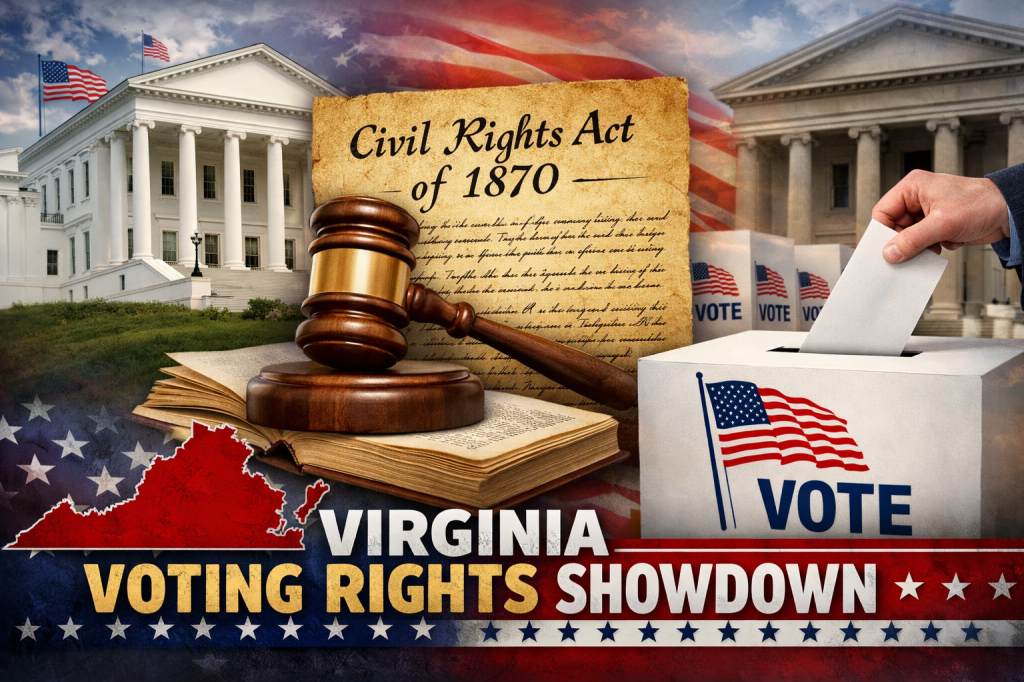
A federal judge has ruled that Virginia unlawfully disenfranchised certain felony offenders in violation of a Reconstruction-era civil rights statute, reopening a long-running debate over voting rights, federal oversight, and the limits of state authority.
The decision, reported by Courthouse News Service, centers on the state’s practice of permanently stripping voting rights from individuals convicted of felonies unless those rights are restored by the governor. The judge found that this policy runs afoul of the Civil Rights Act of 1870, a post-Civil War law designed to prevent states from denying citizens the right to vote based on criminal status when that denial is applied selectively or discriminatorily.
What the Court Found
According to the ruling, Virginia’s system violates federal law because it treats similarly situated citizens differently depending on executive discretion. While the state constitution allows the governor to restore voting rights on a case-by-case basis, the court held that this framework effectively creates unequal access to the ballot — something the Reconstruction Congress explicitly sought to prevent.
The judge emphasized that the Civil Rights Act of 1870 remains enforceable today and was intended to curb state practices that undermine federal voting protections, even when those practices are embedded in state constitutions or long-standing traditions.
Why This Matters Now
Virginia has been at the center of national voting-rights disputes for years. Democratic governors have used executive authority to restore rights to large numbers of former felons, while Republican administrations have typically favored narrower, individualized reviews.
This ruling could significantly limit how much discretion future governors have — regardless of party — by requiring more uniform standards or automatic restoration once a sentence is completed.
From a center-right perspective, the case raises uncomfortable but necessary questions:
- How much power should unelected federal judges have to override state constitutional systems?
- Does a Reconstruction-era statute give Washington too much leverage over state election rules?
- Or does the decision simply enforce equal treatment under the law — a core conservative principle?
Federalism vs. Equal Protection
Supporters of the ruling argue that voting is a fundamental right and that states should not be allowed to gatekeep it through opaque or politically influenced processes. They contend that once someone has served their sentence, continued disenfranchisement amounts to a second punishment not applied evenly.
Critics counter that the Constitution explicitly leaves voter qualifications largely to the states and that federal courts are stretching 19th-century statutes beyond their original scope. They warn the decision could erode state sovereignty and invite further judicial intervention in election administration.
What Happens Next
Virginia officials are expected to appeal, setting up a potential showdown in the Fourth Circuit — and possibly beyond. If upheld, the ruling could force changes not only in Virginia but in other states with similar felony disenfranchisement systems.
At minimum, the case underscores how old laws can produce very modern consequences — and how debates over voting rights remain deeply entangled with questions of federal power, accountability, and constitutional balance.
As the legal fight continues, one thing is clear: this ruling adds new pressure to an already volatile election-law landscape in Virginia — and ensures the issue will remain front-and-center heading into future statewide races.
Support Independent Journalism
Virginia Bay News is part of the Bay News Media Network — a growing group of independent, reader-supported newsrooms covering government accountability, courts, public safety, and institutional failures across the country.
Support independent journalism that isn’t funded by political parties, corporations, or government agencies
Submit tips or documents securely — if you see something wrong, we want to know
Independent reporting only works when readers stay engaged. Your attention, tips, and support help keep these stories alive.
 Virginia Bay News