
By VABayNews Staff
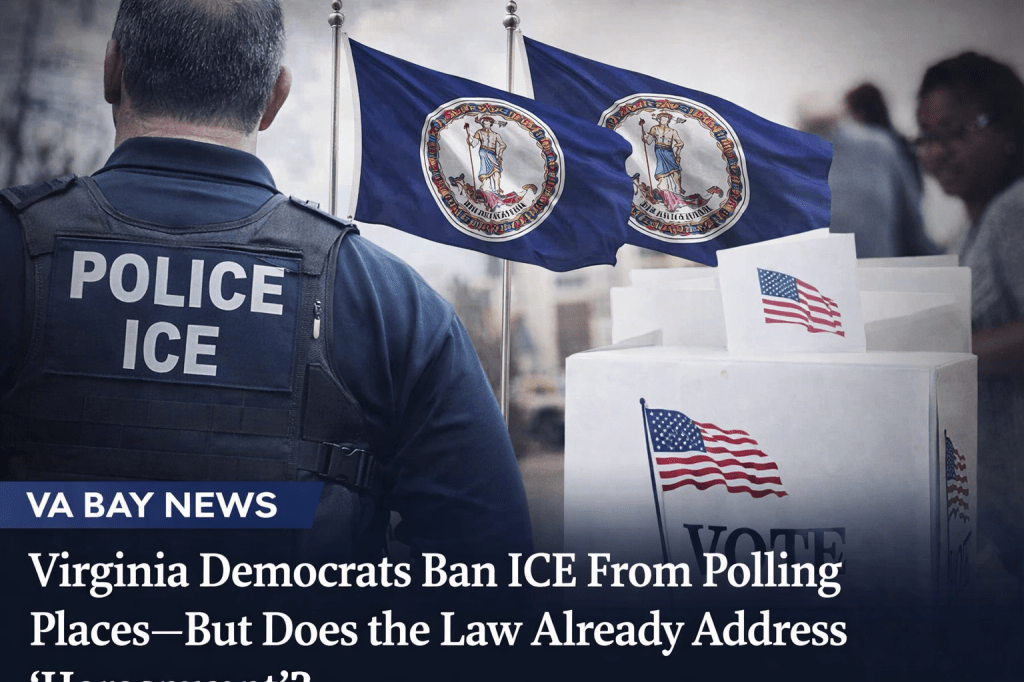
Virginia Democrats are advancing legislation that would prohibit federal immigration enforcement activity within a defined perimeter of polling places—framing the move as a necessary safeguard against voter intimidation.
The bill, House Bill 1442, amends Virginia election law to explicitly ban any federal immigration enforcement action within the polling place buffer zone on Election Day. Supporters argue the measure is needed to prevent intimidation and ensure immigrant communities feel safe participating in elections.
But a closer look raises serious questions about whether the bill addresses a real problem—or simply manufactures one for political effect.
No Evidence of ICE at Virginia Polling Places
There is no documented pattern of U.S. Immigration and Customs Enforcement conducting immigration enforcement operations at Virginia polling locations.
In fact, ICE policy has long restricted enforcement actions at so-called “sensitive locations,” which include schools, churches, hospitals, and polling places—except under extraordinary circumstances. These internal guidelines, while not law, have been in place across multiple administrations.
In short, the behavior the bill claims to stop is already functionally prohibited.
That raises an obvious question: What problem is this bill actually solving?
Existing Law Already Bans Voter Intimidation
Virginia election law already prohibits intimidation, interference, or obstruction of voters at polling places. Election officers, campaign workers, and private individuals are all subject to strict rules governing proximity, conduct, and behavior on Election Day.
If any law enforcement officer—state, local, or federal—were to harass or intimidate voters based on race, ethnicity, or appearance, that conduct would already violate existing civil rights and election laws.
The bill does not meaningfully expand voter protections so much as it singles out one federal agency for symbolic exclusion.
A State–Federal Collision by Design
By explicitly targeting federal immigration enforcement, the legislation steps into constitutionally delicate territory. Immigration enforcement is a federal responsibility, not a state one, and while states can regulate conduct around polling places, they cannot nullify federal authority.
That tension appears intentional.
Rather than strengthening election administration, the bill functions as a political statement—casting Democrats as defenders of marginalized voters while portraying federal immigration enforcement as inherently abusive, even in the absence of evidence.
The Risk of Undermining Confidence
Election integrity depends on public trust. When lawmakers suggest—without proof—that armed federal agents are lurking near polling places to target voters based on skin color, they risk inflaming fear and distrust in the system itself.
Center-right critics argue that this kind of legislation feeds a narrative of victimization rather than reinforcing confidence in existing safeguards.
If lawmakers genuinely believe intimidation is occurring, the appropriate response would be to present evidence, enforce existing law, and hold violators accountable—not pass preemptive legislation based on hypotheticals.
A Solution in Search of a Crisis
Virginia’s elections face real challenges: voter confidence, ballot security, transparency, and administrative competence. Blocking an already-restricted federal agency from a place it does not operate does little to address those concerns.
Instead, House Bill 1442 reflects a broader trend in state politics—using election law as a vehicle for symbolic national messaging rather than practical governance.
Voters deserve laws grounded in reality, evidence, and necessity—not legislation built on worst-case assumptions and political theater.
Support Independent Journalism
Virginia Bay News is part of the Bay News Media Network — a growing group of independent, reader-supported newsrooms covering government accountability, courts, public safety, and institutional failures across the country.
Support independent journalism that isn’t funded by political parties, corporations, or government agencies
Submit tips or documents securely — if you see something wrong, we want to know
Independent reporting only works when readers stay engaged. Your attention, tips, and support help keep these stories alive.
 Virginia Bay News