
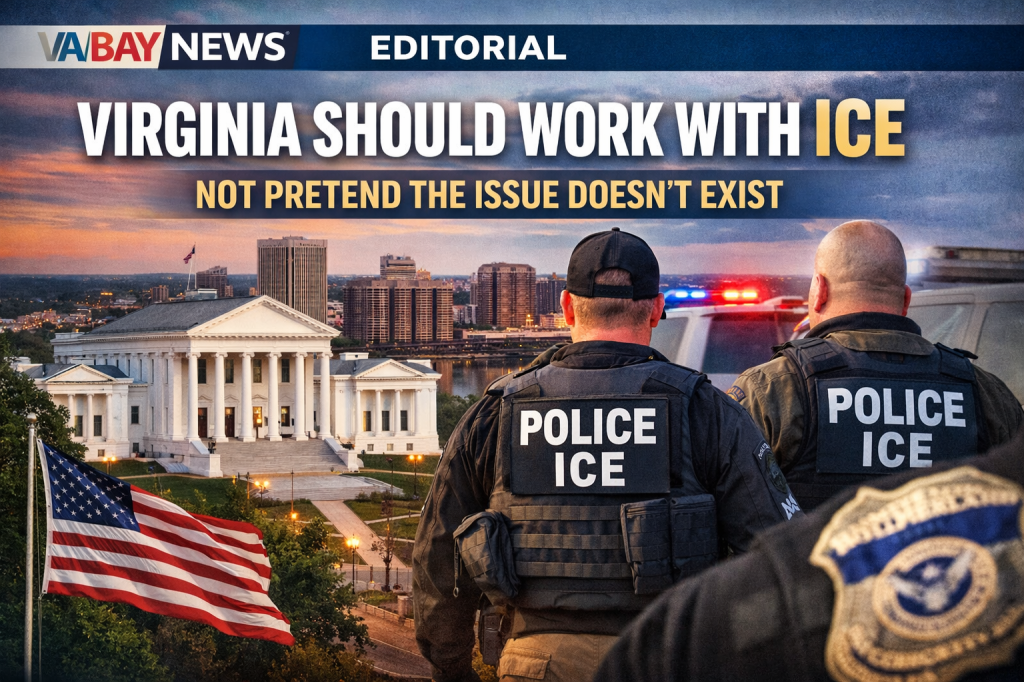
By VABayNews Editorial
As immigration enforcement debates heat up nationwide, Virginia faces a familiar question with real consequences: should state and local officials cooperate with federal immigration authorities, or attempt to wall themselves off from enforcement altogether?
An editorial recently published by RVA Mag frames the arrival of federal immigration enforcement in Richmond as an existential threat — something to be resisted, slowed, or symbolically shut out. But that framing misses the core issue. Cooperation with U.S. Immigration and Customs Enforcement (ICE) is not about ideology. It is about public safety, the rule of law, and honest governance.
Cooperation Is Not Capitulation
Working with ICE does not turn Virginia into a “police state,” nor does it mean indiscriminate raids or mass deportations. It means coordination. Information sharing. Honoring lawful detainers for individuals already in custody who have committed serious crimes.
Virginia already cooperates with federal agencies across a wide range of issues — from drug trafficking to human trafficking to terrorism. Immigration enforcement should not be treated as a uniquely forbidden category simply because it is politically uncomfortable.
When state or local officials refuse to cooperate, the result is not fewer enforcement actions — it is more chaotic ones. Instead of controlled transfers from jails, enforcement happens in communities, workplaces, and public spaces. That is worse for residents, law enforcement, and families alike.
Sanctuary Policies Shift the Burden — They Don’t Remove It
So-called “sanctuary” approaches do not eliminate immigration enforcement; they shift responsibility away from local governments while increasing risk elsewhere. When jurisdictions refuse to coordinate, ICE is forced to operate with less information and fewer safeguards.
That reality undermines the very communities these policies claim to protect.
Virginia has a responsibility to ensure that individuals who pose a genuine threat — violent offenders, repeat criminals, traffickers — are not released simply because of political signaling. Cooperation with federal authorities allows enforcement to be targeted, predictable, and lawful.
Rule of Law Is Not Optional
Virginia cannot selectively decide which federal laws it finds acceptable. Immigration law is federal law. States may debate how it should change, but until it does, deliberate obstruction is not principled resistance — it is abdication.
The center-right position is straightforward: secure borders, humane enforcement, and lawful cooperation between levels of government. These are not mutually exclusive goals. In fact, they depend on one another.
Refusing to work with ICE does not make Virginia more compassionate. It makes governance less honest.
A Pragmatic Path Forward
Virginia lawmakers and local leaders should reject performative resistance and adopt a clear, limited framework for cooperation:
- Coordinate on individuals already in custody for serious crimes
- Maintain transparency about enforcement policies
- Protect due process while honoring lawful detainers
- Focus on public safety, not political theater
The choice is not between compassion and enforcement. The choice is between orderly cooperation and deliberate dysfunction.
Virginia should choose order — and work with ICE.
 Virginia Bay News