
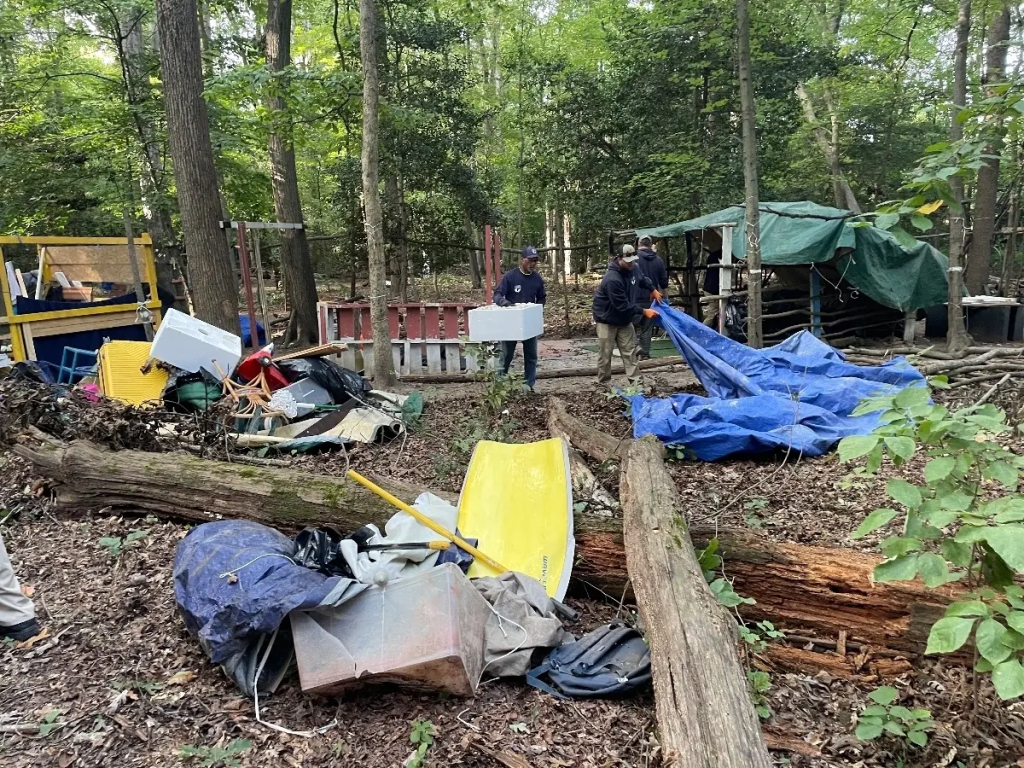
Virginia Democrats are pushing legislation that critics say risks repeating the mistakes of California-style homelessness policy—prioritizing ideology over public safety, local control, and practical outcomes.
At the center of the debate is House Bill 1394, which would prohibit local governments from imposing penalties related to homeless encampments on public property. Supporters frame the bill as a humane response to homelessness. Opponents argue it strips cities and counties of basic authority to manage public spaces—parks, sidewalks, school perimeters, and business corridors—where encampments often emerge.
The Virginia Senate GOP didn’t mince words, warning the bill would make it “impossible” for localities to stop encampments from forming near homes, grocery stores, and schools. While the rhetoric is sharp, the underlying concern is one many Virginians share: what happens when compassion is decoupled from accountability?
What HB 1394 Does—and Why It Matters
HB 1394 would preempt local enforcement, preventing cities and counties from using penalties to address encampments. In practice, that means fewer tools for local officials to respond to health hazards, sanitation issues, blocked sidewalks, and public safety risks—especially when shelters or services are available but declined.
This is not a hypothetical. States and cities that moved in this direction have often seen encampments become entrenched, creating downstream problems: increased emergency calls, needle litter, fires, environmental damage, and harm to nearby small businesses and families. California’s experience is frequently cited—not because Virginia is California, but because policy outcomes matter regardless of geography.
The Local Control Problem
Virginia has long favored local decision-making. HB 1394 flips that tradition by imposing a one-size-fits-all rule from Richmond. Rural towns, suburban counties, and dense cities face different realities; a blanket prohibition on enforcement ignores those differences.
Local officials aren’t asking for the right to criminalize poverty. They’re asking for flexibility—to balance outreach and services with the ability to keep public spaces accessible and safe. Removing that balance doesn’t solve homelessness; it shifts costs and consequences onto neighborhoods least equipped to absorb them.
Compassion vs. Outcomes
There’s a false choice embedded in the debate: that enforcement and compassion cannot coexist. In reality, effective policy requires both. Outreach, treatment, and housing pathways work best when paired with clear expectations about public space use. Without boundaries, services lose leverage and communities lose trust.
Virginians can—and should—support expanded mental health care, addiction treatment, and housing supply. But policy must be judged by outcomes, not intentions. If HB 1394 results in more unsheltered people living in unsafe conditions while communities lose the ability to respond, the bill will have failed everyone it claims to help.
A Better Path Forward
A center-right approach would:
- Preserve local control with guardrails against abuse.
- Tie non-enforcement to real access to shelters and services.
- Require data-driven reporting on outcomes.
- Invest in treatment and transitional housing while maintaining clear rules for public spaces.
Virginia doesn’t need to import another state’s failed experiment. It needs practical solutions that respect communities, protect vulnerable people, and deliver measurable results.
Bottom line: Compassion without accountability isn’t compassion—it’s abdication. And Virginians deserve better.
Support Independent Journalism
Virginia Bay News is part of the Bay News Media Network — a growing group of independent, reader-supported newsrooms covering government accountability, courts, public safety, and institutional failures across the country.
Support independent journalism that isn’t funded by political parties, corporations, or government agencies
Submit tips or documents securely — if you see something wrong, we want to know
Independent reporting only works when readers stay engaged. Your attention, tips, and support help keep these stories alive.
 Virginia Bay News