
By VABayNews Staff
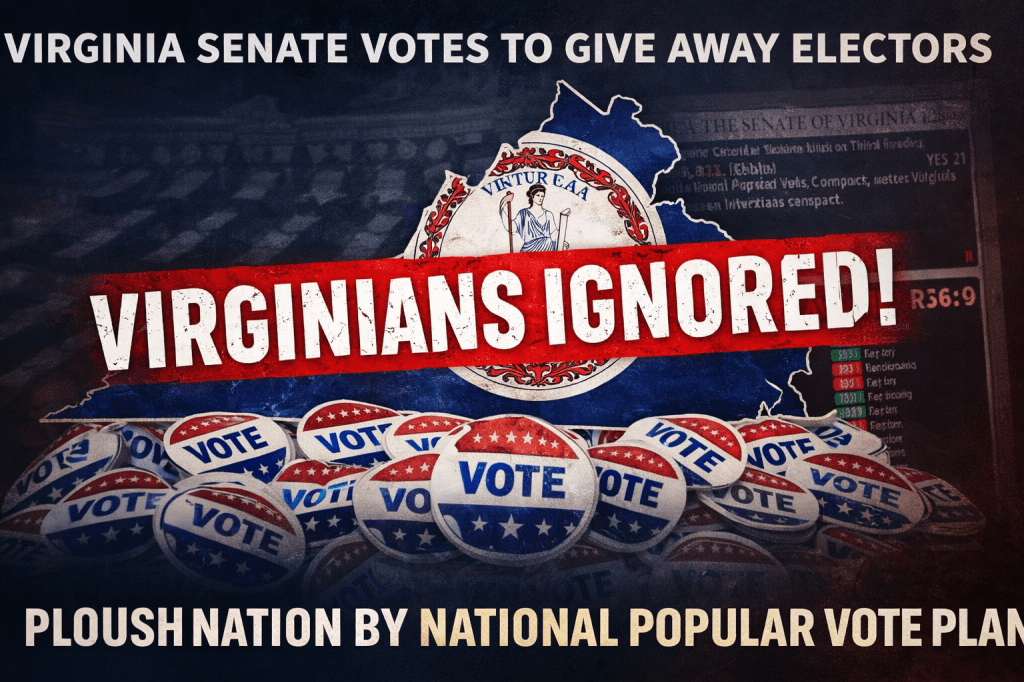
The Virginia Senate has voted to advance legislation that would effectively bind the Commonwealth’s presidential electors to the outcome of the national popular vote—regardless of how Virginians themselves vote.
The bill, SB 322, would place Virginia into the National Popular Vote Interstate Compact, an agreement among participating states to award their electoral votes to the candidate who wins the most votes nationwide, not the most votes within each state.
The measure passed the Senate on a narrow 21–19 vote and now moves to the House of Delegates for consideration.
What the Bill Does
Under the compact, states agree to pool their electoral votes and deliver them to the national popular vote winner once participating states control at least 270 electoral votes—the threshold needed to win the presidency.
Supporters argue the system would “fix” the Electoral College by aligning presidential elections with the national vote tally. Critics counter that it does the opposite: it circumvents the constitutional process without amending the Constitution, shifting power away from individual states and their voters.
Critics: Virginians’ Votes Could Be Overridden
Opponents say the bill undermines the very concept of federalism embedded in the Constitution.
Under the compact, Virginia could vote decisively for one presidential candidate—yet still be required to award all of its electoral votes to another candidate if the national popular vote breaks differently.
“That’s not expanding democracy,” critics argue. “That’s diluting the voice of Virginia voters in favor of population centers elsewhere.”
Rural voters, smaller states, and regions outside major metropolitan areas would see their influence sharply reduced, while presidential campaigns would be further incentivized to focus almost exclusively on high-density urban corridors.
Constitutional Questions Remain
The Constitution explicitly grants states the authority to appoint electors and establishes the Electoral College as the mechanism for presidential elections. Changing that system traditionally requires a constitutional amendment—not an interstate agreement.
Legal scholars have raised unresolved questions about whether the compact would survive constitutional scrutiny, particularly if implemented during a contested election.
Congress has not formally approved the compact, and no court has definitively ruled on its legality once activated.
What the Constitution Says
Article II, Section 1 of the U.S. Constitution grants each state the authority to appoint presidential electors “in such Manner as the Legislature thereof may direct.” This power is paired with the Electoral College, a system deliberately designed to balance the influence of large and small states, urban and rural voters, and regional interests.
The Constitution does not provide for a national popular vote for president. Changing the method of electing the president traditionally requires a constitutional amendment, not an interstate agreement.
Supporters of the National Popular Vote Interstate Compact argue states may voluntarily coordinate how they appoint electors. Critics counter that once states bind their electors to votes cast outside their borders, they effectively bypass the Electoral College without voter consent or constitutional amendment—raising serious questions about federalism, state sovereignty, and election legitimacy.
No court has yet ruled on whether the compact is constitutional once activated, leaving open the possibility of legal challenges during a close or contested presidential election.
A Party-Line Vote With Lasting Consequences
The narrow margin in the Senate underscores how divisive the issue remains. Republicans and some moderate Democrats warned that the compact risks destabilizing presidential elections and invites legal chaos in close contests.
Supporters, meanwhile, frame the move as part of a broader national push to reshape election rules after repeated losses under the current system.
What Happens Next
The bill now heads to the House of Delegates, where its fate remains uncertain. If passed and signed into law, Virginia would join other states in a pact that could fundamentally alter how presidential elections are decided—without voters ever casting a ballot on the change themselves.
For now, the question facing Virginians is simple: Should the Commonwealth’s electoral votes reflect Virginia’s voters—or the national tally?
Support Independent Journalism
Virginia Bay News is part of the Bay News Media Network — a growing group of independent, reader-supported newsrooms covering government accountability, courts, public safety, and institutional failures across the country.
Support independent journalism that isn’t funded by political parties, corporations, or government agencies
Submit tips or documents securely — if you see something wrong, we want to know
Independent reporting only works when readers stay engaged. Your attention, tips, and support help keep these stories alive.
 Virginia Bay News