
By VABayNews Staff
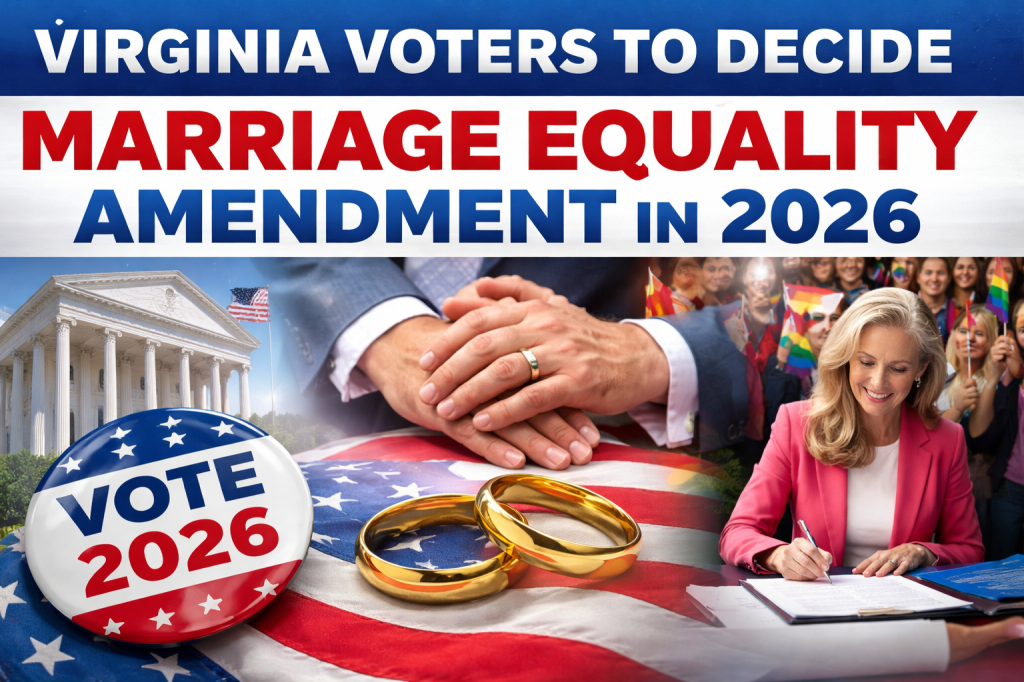
RICHMOND, Va. — Governor Abigail Spanberger has signed legislation placing a proposed Marriage Equality Amendment on Virginia’s 2026 general election ballot, clearing the final procedural hurdle needed to ask voters whether the state constitution should be updated to protect same-sex marriage.
The amendment would remove language tying marriage exclusively to one man and one woman and replace it with gender-neutral wording. While same-sex marriage is already legal nationwide under Obergefell v. Hodges, supporters argue that embedding protections in Virginia’s constitution provides an additional safeguard should federal precedent change.
What Just Happened
Under Virginia law, constitutional amendments must pass two separately elected General Assemblies before going to voters. Lawmakers approved the measure again this session, and the governor’s signature formally sends it to the ballot. Virginians will have the final say in November 2026.
A Broad Coalition—With Cautions
Democrats framed the move as a civil-rights guarantee and a signal of stability to families and employers. Some Republicans joined the final vote, emphasizing that the amendment does not compel religious institutions to change their doctrines or practices.
Center-right voices, however, raised familiar concerns: whether constitutionalizing social policy crowds out other pressing priorities, and whether voters are being asked to settle an issue already resolved in daily life and federal law. Others urged clarity that religious liberty protections remain intact and enforceable.
Why This Matters to Voters
For supporters, the amendment offers certainty—especially amid national debates over the durability of Supreme Court precedents. For skeptics, the question is one of process and priorities: Should the constitution be amended for issues already governed by statute and federal rulings, or should amendments be reserved for narrower questions of structure and rights?
What’s Next
The measure now moves to the campaign phase. Expect advocacy groups on both sides to mobilize, fundraising to ramp up, and messaging to focus on legal certainty vs. constitutional restraint. With turnout dynamics in an off-year election and a diverse electorate, the outcome is not preordained.
Bottom line: Virginia voters—not lawmakers—will decide in 2026 whether marriage equality belongs in the state constitution. The debate is likely to be less about everyday practice and more about the proper role of constitutional amendments in a changing legal landscape.
Support Independent Journalism
Virginia Bay News is part of the Bay News Media Network — a growing group of independent, reader-supported newsrooms covering government accountability, courts, public safety, and institutional failures across the country.
Support independent journalism that isn’t funded by political parties, corporations, or government agencies
Submit tips or documents securely — if you see something wrong, we want to know
Independent reporting only works when readers stay engaged. Your attention, tips, and support help keep these stories alive.
 Virginia Bay News