
By VABayNews Staff
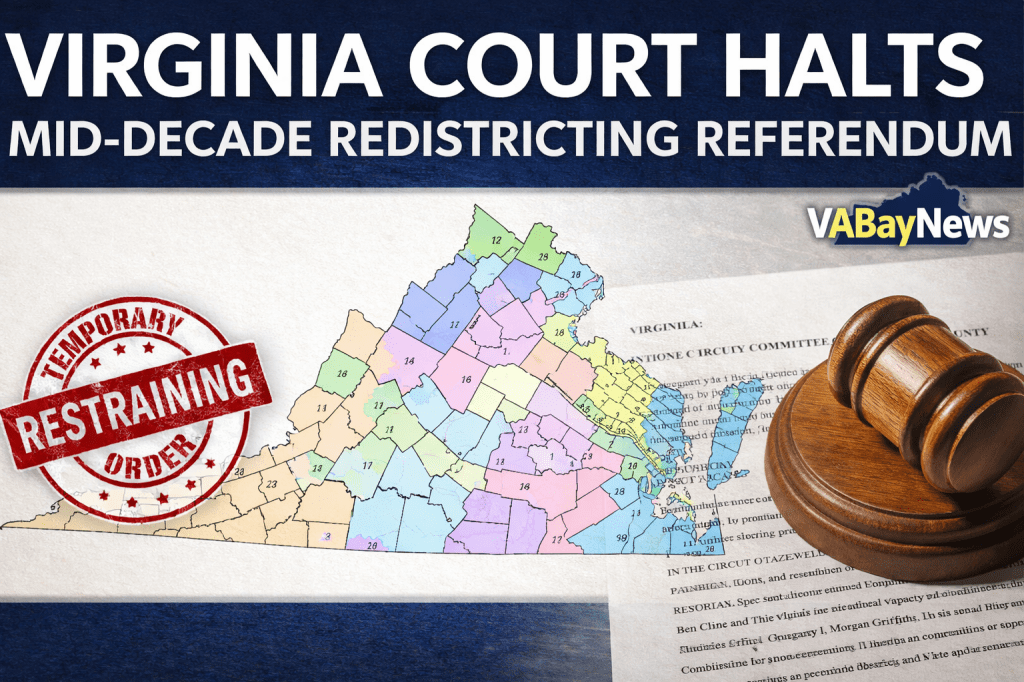
Newly released court documents from the Circuit Court of Tazewell County confirm what many suspected: this was not a symbolic pause — it was a direct judicial order stopping election officials from moving forward.
The case, filed by the Republican National Committee, the National Republican Congressional Committee, and U.S. Representatives Ben Cline (VA-6) and Morgan Griffith (VA-9), names as defendants the Virginia Department of Elections, members of the Virginia State Board of Elections, and Tazewell County election officials in their official capacities.
Judge Jack Hurley Jr.’s order is explicit.
What the Order Actually Says
The court:
“GRANTS Plaintiffs’ Emergency Motion for Temporary Restraining Order.”
And further:
All defendants are “TEMPORARILY RESTRAINED” from administering, preparing for, or taking any action to further the procedure of the referendum on House Joint Resolution 6007.
That includes:
- Preparing ballots
- Certifying election logistics
- Advancing early voting procedures
- Taking administrative steps toward holding the April referendum
This is not merely advisory language. It is a binding order preventing state and local election officials from moving forward while litigation continues.
Why This Matters
This ruling does more than slow down a partisan fight.
It freezes the machinery of an election.
Democrats in Richmond had pushed House Joint Resolution 6007 during a special session to authorize mid-decade congressional redistricting — an extraordinary move that critics say was designed to flip up to four Republican-held seats before the 2026 midterms.
Republicans argued the amendment process violated:
- Virginia’s constitutional procedural requirements
- Mandatory timing rules
- Public notice provisions
- Legislative sequencing requirements
Judge Hurley agreed there was sufficient likelihood of constitutional defects to justify emergency relief.
That is a significant threshold.
Courts do not grant Temporary Restraining Orders lightly. Plaintiffs must show a strong likelihood of success on the merits and irreparable harm if relief is not granted.
The court found that standard met.
The “50% Disenfranchised” Claim
Some social media posts have claimed the map would have “disenfranchised nearly 50% of voters.”
That number is rhetorical, not a formal court finding.
The argument from Republicans is that dramatically reshaping districts to dilute conservative voting blocs — particularly in suburban and exurban areas — would weaken the electoral influence of roughly half the state’s voters.
Whether that constitutes “disenfranchisement” in a legal sense remains unresolved. Courts have not ruled on the substance of any proposed map because no final map was enacted.
The Bigger Constitutional Question
At stake is not simply which party benefits.
The underlying issue is whether the General Assembly can use a special session to rush a constitutional amendment onto the ballot in a compressed timeframe, particularly when early voting and election administration timelines are already constrained by law.
Virginia’s Constitution includes specific amendment procedures. Republicans argue Democrats attempted to shortcut those guardrails in pursuit of national partisan leverage.
Democrats counter that mid-decade redistricting is necessary to respond to Republican map changes elsewhere.
But courts do not decide based on partisan fairness arguments. They decide based on constitutional compliance.
For now, the court has said: pause.
What Happens Next
- Democrats are expected to appeal immediately to the Virginia Supreme Court.
- The high court could reverse the TRO — or uphold it.
- If upheld, the April 21 referendum cannot proceed.
- If overturned, election officials would need to rapidly restart preparations.
Time is now the central factor.
Election administration is calendar-driven. Even a temporary delay can effectively kill a ballot measure.
A National Battle Playing Out in Virginia
This case is part of a broader national escalation over congressional maps.
Republicans have pursued aggressive redraws in states like North Carolina. Democrats have explored similar strategies in states where they control legislatures.
Virginia — long considered politically competitive — has become the newest front.
If Democrats were able to convert Virginia’s delegation to something approaching 10-1, it could materially affect control of the U.S. House.
That is why national party organizations stepped into this case.
Bottom Line
The court order confirms this is not social media hyperbole.
A Virginia judge has formally restrained election officials from moving forward with a mid-decade redistricting referendum.
Whether this stands will now depend on the Virginia Supreme Court.
But for today, the brakes are on.
VABayNews will continue monitoring the legal filings, appellate action, and any developments from Richmond as this high-stakes constitutional fight unfolds.
Support Independent Journalism
Virginia Bay News is part of the Bay News Media Network — a growing group of independent, reader-supported newsrooms covering government accountability, courts, public safety, and institutional failures across the country.
Support independent journalism that isn’t funded by political parties, corporations, or government agencies
Submit tips or documents securely — if you see something wrong, we want to know
Independent reporting only works when readers stay engaged. Your attention, tips, and support help keep these stories alive.
 Virginia Bay News