
By VABayNews Staff
When Virginia Democrats campaigned on “affordability,” many voters assumed they meant lower grocery bills, relief at the gas pump, and a break from soaring utility costs.
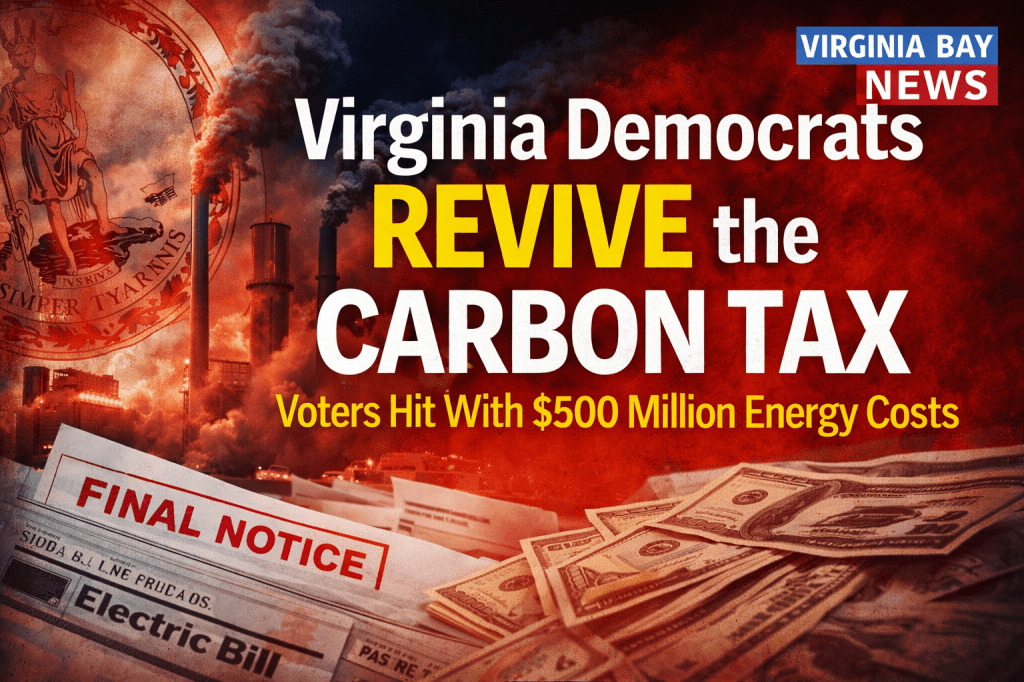
Instead, they just voted to rejoin the Regional Greenhouse Gas Initiative (RGGI) — effectively reviving what critics call a backdoor carbon tax projected to siphon roughly $500 million per year from Virginians.
As Del. Karen Hamilton bluntly put it: Actions speak louder than words.
What Just Happened
In a contested committee vote, House Democrats pushed through a budget amendment requiring Virginia to rejoin RGGI — the multistate compact that caps carbon emissions from power plants and forces utilities to purchase carbon allowances.
Those costs don’t disappear.
They land squarely on:
- Working families’ electric bills
- Small businesses already squeezed by inflation
- Rural communities dependent on affordable power
- Seniors on fixed incomes
Supporters call it climate policy. Opponents call it a tax — one that never appeared as a line item on the campaign trail.
The $500 Million Question
RGGI functions by requiring power generators to buy emissions credits. Utilities then pass those costs along to ratepayers.
In practice, that means:
- Higher monthly electricity bills
- Increased operating costs for manufacturers
- Higher prices baked into goods and services
At a time when Virginians are still feeling the aftershocks of inflation, Richmond Democrats just voted to layer on another structural cost.
And for what?
Virginia’s emissions were already declining before RGGI. The state has steadily shifted toward natural gas and renewables. Critics argue RGGI simply monetizes that trend — turning environmental virtue signaling into a recurring revenue stream.
The Affordability Contradiction
The political optics are striking.
The same lawmakers who warn about “corporate greed” and “cost-of-living crises” have now embraced a program that guarantees higher utility bills.
You cannot:
- Campaign on lowering costs
- Warn about economic inequality
- Then approve a half-billion-dollar-per-year energy burden
Without consequences.
This isn’t abstract climate theory. It’s real money. Every month. On every bill.
Who Pays the Most?
Energy costs hit lower- and middle-income households hardest.
Wealthier Virginians may absorb a few extra dollars per month without blinking. For working families, that margin matters — especially when:
- Food costs remain elevated
- Insurance premiums are rising
- Mortgage and rent payments are climbing
RGGI doesn’t care about your zip code. It simply adds cost.
Climate Policy or Political Posturing?
Proponents argue RGGI funds environmental and flood mitigation projects.
But critics note:
- Virginia withdrew from the program before and survived just fine
- Energy markets were already trending cleaner
- Regional competitiveness matters when neighboring states have lower power costs
Businesses considering relocation look at one thing first: operating costs.
Higher electricity rates do not attract investment.
They repel it.
A Warning for 2026
This vote will not go unnoticed.
Energy affordability is one of the most tangible kitchen-table issues in Virginia politics. Voters don’t need white papers to understand a higher electric bill.
They will see it.
They will feel it.
And they will remember who voted for it.
Bottom Line:
Virginia Democrats just voted to rejoin RGGI — reimposing what critics call a carbon tax that could cost ratepayers roughly $500 million per year. In a state where affordability was supposed to be the priority, Richmond just made energy more expensive.
Actions speak louder than campaign slogans.
Support Independent Journalism
Virginia Bay News is part of the Bay News Media Network — a growing group of independent, reader-supported newsrooms covering government accountability, courts, public safety, and institutional failures across the country.
Support independent journalism that isn’t funded by political parties, corporations, or government agencies
Submit tips or documents securely — if you see something wrong, we want to know
Independent reporting only works when readers stay engaged. Your attention, tips, and support help keep these stories alive.
 Virginia Bay News