
By Michael Phillips | VABayNews | Thunder Report
This article reflects disputed accounts drawn from court filings, official reports, and interviews.
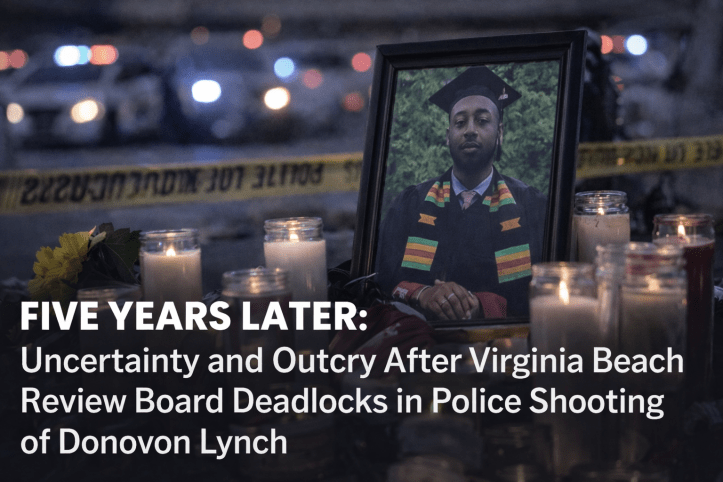
VIRGINIA BEACH, Va. — Nearly five years after Donovon Lynch was fatally shot by a Virginia Beach police officer at the Oceanfront, the city’s civilian oversight body has failed to reach a consensus on the case — issuing no findings, no recommendations, and no formal conclusion.
For the Lynch family and their supporters, the Independent Citizen Review Board’s (ICRB) deadlock feels less like oversight and more like institutional paralysis: a system built to restore public confidence that cannot deliver a civic answer when the case demands one.
For city officials, the board operated within its structure.
For the broader public, the question now is whether an oversight mechanism designed to bridge trust gaps can function effectively when it cannot reach agreement — and whether “procedurally complete” is the same thing as “socially resolved.”
This is the story of what the official process concluded, what the family contests, and why five years later the dispute remains one of the most consequential public-safety controversies in Virginia Beach’s recent history.
A Case That Never Quieted
Donovon Lynch was shot and killed on March 26, 2021, during a chaotic night of multiple shootings at the Virginia Beach Oceanfront. The city’s official narrative has long emphasized the scale and speed of the crisis: overlapping scenes, multiple victims, officers running toward gunfire while trying to protect civilians and secure areas.
In November 2021, a Special Grand Jury concluded there was no probable cause to charge Officer Solomon Simmons, determining that he acted in justifiable self-defense after reviewing extensive evidence, including body camera footage, surveillance video, witness testimony, photographs, and forensic evidence.
That criminal review closed one chapter.
But it did not close the case in the eyes of Lynch’s father, Wayne Lynch — or in the eyes of supporters who argue the official conclusion relies on a version of events that remains contested, incomplete, and structurally insulated from meaningful public challenge.
“It has been almost five years that we have been fighting for justice,” Wayne Lynch wrote in a public statement as the anniversary approaches. “The fight continues.”
The Lynch family maintains that critical questions were never fully addressed in a public forum capable of restoring trust — and that subsequent events, including a perjury referral against their attorney and now a civilian review board deadlock, have only deepened the perception of institutional defensiveness.
A Night of Chaos — and a Body Camera Gap That Never Went Away
The Special Grand Jury report includes a detail that became central to public skepticism: body camera activity surrounding the minutes leading to Donovon’s death.
According to the report, Officer Simmons initially had his body camera activated while assisting a victim from an earlier shooting. The report states the camera was later deactivated while Simmons entered his vehicle, and that he radioed dispatch confirming deactivation as he was escorting a victim toward the hospital.
Roughly 26 minutes later, the report describes additional gunfire erupting near the 19th Street parking lot, turning that area into a “war zone.” Simmons exited his vehicle and ran toward the scene after hearing what the report characterizes as a barrage of gunfire — but did not reactivate his body camera before encountering Lynch.
The absence of body camera footage at the most pivotal moment remains one of the most enduring issues in the case. Even when investigators rely on other cameras, surveillance, and witness accounts, the lack of the primary officer’s body camera during the decisive seconds becomes a structural vulnerability — one that fuels doubt regardless of what later reviews conclude.
The Special Grand Jury itself acknowledged the body camera issue through recommendations aimed at preventing similar gaps, including changes to ensure body cameras automatically activate while officers are on duty.
For critics, the very existence of that recommendation is an admission that the system failed at the moment transparency mattered most.
For the city, the grand jury’s review of substantial other evidence is presented as sufficient.
Five years later, both positions still collide.
What the Special Grand Jury Said Happened
The Special Grand Jury’s narrative of the moment of the shooting centers on a perceived threat.
According to the report, as Simmons moved through the area, he heard what he believed was the “racking” of a firearm and observed an individual near a hedge line. The report indicates that witnesses corroborated hearing someone shout “gun, gun, gun.”
The grand jury concluded Simmons perceived a threat to himself and others and fired.
It further found that forensic evidence was consistent with the self-defense determination, and that the evidence it reviewed did not support criminal charges.
For residents who accept the report as definitive, the legal conclusion is straightforward: the officer’s perception, in a violent, fast-moving situation, fell within lawful self-defense.
But for the Lynch family and their supporters, the report’s conclusion is not “wrong” only in outcome — they argue it is wrong in its underlying assumptions, what it elevates, what it minimizes, and what it fails to reconcile publicly.
The Civilian Oversight Process — and Why a Deadlock Matters
Virginia Beach’s Independent Citizen Review Board was created to provide civilian review of police conduct — and, more broadly, to strengthen public trust when police incidents become contentious.
The board’s authority is advisory. It can review, deliberate, and recommend policy changes or actions to city leadership. But it does not have the power to:
- file criminal charges
- discipline officers directly
- override prosecutorial decisions
- reopen grand jury conclusions
Its strength lies in transparency and recommendations.
Its weakness lies in structural limitations — including membership, quorum rules, voting thresholds, and the reality that some boards cannot issue formal recommendations without consensus.
According to local reporting, the ICRB recently reviewed the Lynch case but failed to reach the required consensus among its members. The board is reportedly operating short of its full complement.
Without consensus, no recommendations can be formally transmitted to the City Manager.
The result: no official advisory position.
That procedural outcome has reignited debate over whether Virginia Beach’s oversight mechanisms are equipped to handle cases of this magnitude — and whether “no conclusion” functions, in practice, as a form of institutional self-protection.
A deadlock may be procedurally valid.
But in a high-profile death, it can appear to the public as a non-decision — a vacuum.
And vacuums do not restore trust. They harden competing narratives.
The Body Movement Dispute
One of the most sensitive disputes involves what happened after Donovon was shot — specifically, the movement of his body.
The Special Grand Jury report addresses this issue directly. It states that medical attention was rendered, that EMS could not safely approach because of the proximity to the 19th Street lot amid continued danger, and that Lynch was moved to a “safe zone” in the 200 block of 20th Street where aid continued until he was pronounced dead.
The grand jury’s framing presents the movement as tactical and safety-driven — consistent with a scene still threatened by ongoing gunfire and uncertainty.
But the Lynch family, including attorney Jeff Reichert, has repeatedly advanced a different theory: that the movement was not merely safety-based but narrative-shaping.
In Reichert’s telling, the movement matters because it changes how the shooting is perceived: where Lynch was found, what he was connected to, and how his death is situated relative to the broader chaos that night.
Reichert has described returning to the scene with the family and with the man who was with Donovon at the time of the shooting, walking the path and identifying the location where Donovon went down.
Reichert has stated that during that walk-through, he discovered a business card in the grass — and that Donovon’s sister said the card had been in Donovon’s pocket earlier that day, tied to a routine stop (such as work done on his car). In Reichert’s view, that detail suggested the original location and later location of the body did not match — raising the suspicion that something about the scene had been altered in a way that affected the public story.
The grand jury did not adopt that interpretation.
But the presence of two irreconcilable frames — “moved for safety” versus “moved to stage the narrative” — is exactly the kind of civic conflict oversight boards are created to confront with transparent findings.
A deadlock leaves it unresolved.
Medical Aid and the “Could He Have Survived?” Question
The Special Grand Jury states aid was rendered and continued after relocation.
But the family’s advocacy has long focused on the immediacy and adequacy of medical response — and whether the decisions made at the scene reduced Donovon’s chance of survival.
In civil litigation, Dr. Darrin Porcher, a police-practices expert retained by the Lynch estate, advanced a critical view: that the officer failed to employ proper identification and de-escalation steps, and that immediate lifesaving measures and policy-driven medical response expectations were not met.
Reichert has gone further in public storytelling, arguing that Donovon remained alive long enough that faster transport could have changed the outcome — and that choices made in the aftermath deserve far more scrutiny than they have received.
It is important to separate what is established from what is alleged:
- It is established in the grand jury narrative that Lynch was moved, and that aid continued.
- It is alleged by the family and their attorney that the movement and timing may have compromised lifesaving care and altered the narrative.
Those allegations are among the central reasons the family insists the case is not resolved in any meaningful moral sense, regardless of legal finality.
The Attorney at the Center — and the Perjury Investigation
The Special Grand Jury’s 2021 report included an unusual additional recommendation: investigation of Jeff Reichert — the attorney for the Lynch family — for possible perjury.
That recommendation carried significant reputational weight. It shifted part of the public conversation away from the officer and toward the family’s advocate — creating a cloud of suspicion in a case already defined by contested facts.
Reichert has publicly maintained that the recommendation was unfounded and damaging to his professional standing, describing it as extraordinary, retaliatory, and intended to discredit the legal team challenging the official narrative.
However, Reichert was later investigated and cleared. Prosecutors concluded there was insufficient evidence to pursue perjury charges. No charges were filed, and the investigation did not result in prosecution.
The clearance is a critical piece of the story. It means:
- The officer was not charged.
- The family’s attorney was not charged.
- The criminal investigation is legally closed.
Yet socially and politically, the dispute continues — and the perjury episode has become part of the family’s broader argument that the system protects itself by shifting scrutiny onto challengers.
The Civil Case: The City’s Defensive Narrative
In civil court filings, the City of Virginia Beach has denied wrongdoing and asserted that Officer Simmons acted reasonably under the circumstances.
The city’s defense also advances claims that Donovon’s actions contributed to his own death — including allegations that he entered an active shooting situation, crouched behind shrubbery, chambered a round in his firearm, and rose/turned with a loaded weapon. The city also asserted, on information and belief, that Lynch may have been under the influence of alcohol.
This matters because it illustrates how the city frames responsibility:
- The environment was chaotic.
- The officer’s perception was reasonable.
- The victim’s conduct contributed to the outcome.
For the Lynch family, this reads like victim-blaming — a narrative designed to move the case from “did the officer act properly?” to “why was Donovon there and what was he doing?”
That framing is not unique to this case. But in high-profile deaths, it often becomes gasoline — especially when key video is missing and oversight bodies do not issue public conclusions.
The Family’s Ongoing Dispute
Wayne Lynch and Reichert continue to challenge aspects of the official narrative. Among the concerns raised publicly over the years:
- whether proper identification and warnings were given prior to the shooting
- body camera activation issues
- officer protocol compliance
- the movement of Donovon Lynch’s body after the shooting
- Whether all witnesses were adequately considered.
These concerns remain disputed. This includes the individual Donovon was with, who witnessed the officer shooting. Why has his account been buried?
The Special Grand Jury concluded Simmons perceived a threat after hearing a gun being racked, and that witness testimony supported his account. It further found that forensic evidence aligned with self-defense.
The Lynch family, however, argues that important questions were not fully reconciled in a public forum and that investigative conclusions do not align with their understanding of the events. It’s alleged that officers did not even know that Lynch had a gun in his pocket until it was raised several days after the shooting. He was a licensed carrier. They never searched his body after he was shot.
This divergence — between official conclusion and family belief — is the engine of the ongoing controversy.
The Broader Context: Donovon Lynch’s Legacy
Supporters of the Lynch family emphasize Donovon’s background and community involvement.
He was a small business owner, a growing entrepreneur, a former college athlete, and a mentor figure in youth sports circles. Family members, including Reichert, have said he was preparing to help organize a basketball camp in the community before his death — a detail repeatedly cited to counter narratives that reduce him to a chaotic night at the Oceanfront.
In 2025, Hampton Mayor James A. Gray Jr. issued a letter honoring Donovon Lynch’s life and acknowledging his family’s legacy in the Hampton Roads community.
For supporters, those tributes reinforce their belief that the case should not fade into procedural closure.
For critics of the city’s process, they underscore the human cost: that in the gap between legality and legitimacy sits a father who still believes the system failed his son. A system he has spent decades working for in juvenile detention.
Governance Questions Raised by the Deadlock
The ICRB’s inability to reach consensus raises structural questions:
- What happens when a review board cannot reach an agreement?
- How are vacancies filled, and how quickly?
- Does advisory-only authority meaningfully restore public confidence?
- Should controversial cases require published minority reports when consensus fails?
In high-profile cases, oversight design matters.
A deadlock may be procedurally valid. But it can also appear — to the public — as a non-decision.
Transparency advocates often argue that even divided boards can issue split reports to articulate competing interpretations, documenting where members agree and where they differ.
Whether Virginia Beach’s structure permits that, requires it, or discourages it is not always clear to the public — and lack of clarity is itself a trust problem.
Where Things Stand Now
As of this writing:
- No criminal charges were filed against Officer Simmons.
- A Special Grand Jury found no probable cause and concluded self-defense.
- Attorney Jeff Reichert was investigated and cleared of perjury.
- The Independent Citizen Review Board failed to reach consensus.
- No recommendations were forwarded to city leadership.
- There has been no announcement of additional state or federal prosecutorial action.
- The civil dimension of the case continues to shape the broader conversation about accountability.
And in the absence of a definitive civic statement from the city’s oversight body, the case continues to live in competing realities:
- A legal reality of closure.
- A family reality of unresolved questions.
- A public reality of fractured trust.
A Case Closed Legally — But Not Publicly
The legal system delivered conclusions.
But public acceptance of those conclusions remains fractured.
For some residents, the Special Grand Jury’s findings are definitive.
For others — including the Lynch family — the absence of charges does not equal the absence of unresolved questions.
Oversight bodies exist to bridge that divide.
When they cannot deliver a conclusion, the divide often widens.
Five Years Later
The fifth anniversary of Donovon Lynch’s death arrives not with a new ruling, not with a new charge, not with a policy overhaul — but with a review board deadlock.
For Wayne Lynch, that does not end the matter. He wants his son’s name cleared of any wrongdoing.
For city officials, the process operated within its bounds.
For Virginia Beach, the unresolved tension between official findings and public belief continues to define the case.
Whether the next chapter brings renewed investigation, policy reform, or continued stalemate remains uncertain.
What is clear is this:
Five years later, the case of Donovon Lynch remains one of the most consequential and contested police-involved shootings in Virginia Beach’s recent history — not because the courts are still deciding, but because the community is.
In the years since Donovon’s death, Wayne Lynch has continued his advocacy through the Donovon & Wayne Lynch Foundation, which focuses on community engagement, youth initiatives, and justice reform efforts.
Support Independent Journalism
Virginia Bay News is part of the Bay News Media Network — a growing group of independent, reader-supported newsrooms covering government accountability, courts, public safety, and institutional failures across the country.
Support independent journalism that isn’t funded by political parties, corporations, or government agencies
Submit tips or documents securely — if you see something wrong, we want to know
Independent reporting only works when readers stay engaged. Your attention, tips, and support help keep these stories alive.
 Virginia Bay News