By VABayNews Staff
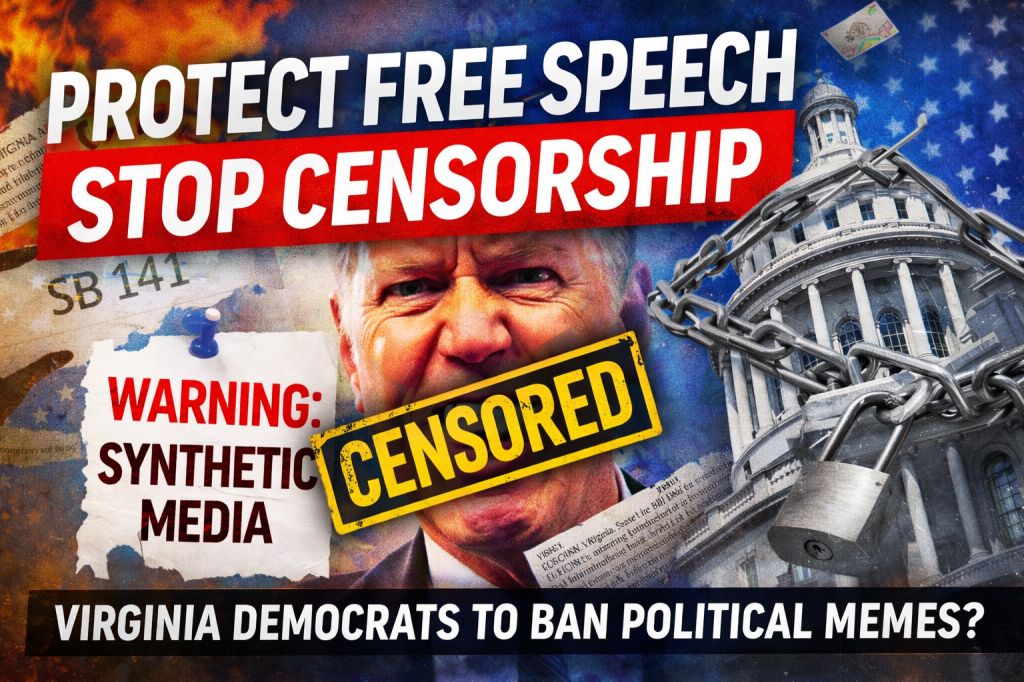
Virginia lawmakers are advancing legislation that critics warn could chill political speech and open the door to lawsuits over everything from campaign ads to internet memes.
The measure, SB141, titled “Political campaign advertisements; synthetic media, penalty,” seeks to regulate the use of artificially generated or altered media in election-related communications. Supporters say the bill is meant to prevent deceptive “deepfake” content in campaigns. But opponents argue the legislation is written so broadly that it could ensnare ordinary political commentary and satire.
For a state that prides itself on constitutional liberties, the proposal is raising uncomfortable questions about where election integrity ends and censorship begins.
What the Bill Actually Does
The bill prohibits election-related communications containing “synthetic media” from being distributed without a conspicuous disclaimer stating that the content has been artificially generated or altered.
The required statement would read:
“This message contains synthetic media that has been altered from its original source or artificially generated and may present conduct or speech that did not occur.”
Violations could trigger:
- Civil penalties of up to $25,000
- A Class 1 misdemeanor for willful violations
- Private lawsuits from any registered voter who receives the communication
In other words, a voter who believes they received an altered or AI-generated campaign message without the mandated disclaimer could potentially take legal action.
Supporters argue the measure is necessary as artificial intelligence makes it easier to create convincing fake videos or images of candidates.
But critics say the bill’s language sweeps far beyond deepfake disinformation.
The Meme Problem
Political memes—images altered for humor, parody, or criticism—have become a staple of modern political discourse. From late-night television jokes to viral social media posts, satire has long played a role in American political culture.
Under the language of SB141, however, a meme featuring a modified image of a candidate could technically qualify as “synthetic media.”
That creates a potential legal minefield.
Would a parody image of a candidate on social media require a government-approved disclaimer? Could a campaign volunteer sharing a humorous meme face legal consequences? Could activists or independent commentators be dragged into court because a voter claims they received altered content?
Those questions remain largely unanswered.
The bill’s critics argue that when laws governing political speech become vague, the result is predictable: self-censorship.
People stop speaking not because they are guilty of wrongdoing, but because they fear the legal risk.
The First Amendment Tension
The United States Supreme Court has repeatedly ruled that political speech enjoys the highest level of constitutional protection.
Satire, parody, and exaggerated political commentary are deeply rooted in American tradition. From the pamphlets of the Founding era to modern social media posts, Americans have long used humor and exaggeration to criticize those in power.
The concern with SB141 is not the goal of combating deepfake deception. That is a legitimate issue.
The concern is that the mechanism chosen to address it may entangle ordinary political expression in legal uncertainty.
When laws create the possibility that voters themselves can file legal actions over disputed content, the result can be a flood of politically motivated complaints and litigation.
And in highly polarized political environments, that risk is far from theoretical.
A National Trend Toward Speech Regulation
Virginia is not alone in exploring regulations around AI-generated political content. Legislatures across the country are grappling with how to handle deepfakes in election campaigns.
But critics warn that many proposals are being rushed forward before policymakers fully understand how digital speech actually works.
The internet is filled with edited images, satirical videos, and parody accounts. Attempting to regulate all altered media in political messaging could easily sweep up harmless commentary along with malicious deception.
The difference between misinformation and satire is often obvious to human audiences—but difficult to codify in law.
Election Integrity vs. Political Expression
Protecting voters from deceptive deepfake content is a legitimate policy objective. But legislation aimed at addressing that problem must tread carefully.
The First Amendment exists precisely because governments have historically attempted to regulate speech they considered dangerous or misleading.
Today, the target may be AI-generated campaign videos. Tomorrow, it could be online commentary that someone finds politically inconvenient.
Virginia lawmakers face an important choice.
They can craft narrow protections against genuinely deceptive deepfake campaigns.
Or they can create a legal regime where ordinary political speech—from memes to satire—carries the risk of fines, lawsuits, or criminal penalties.
For a state founded on the principles of Jefferson and Madison, the answer should be obvious.
Support Independent Journalism
Virginia Bay News is part of the Bay News Media Network — a growing group of independent, reader-supported newsrooms covering government accountability, courts, public safety, and institutional failures across the country.
Support independent journalism that isn’t funded by political parties, corporations, or government agencies
Submit tips or documents securely — if you see something wrong, we want to know
Independent reporting only works when readers stay engaged. Your attention, tips, and support help keep these stories alive.
 Virginia Bay News