
By VABayNews Staff
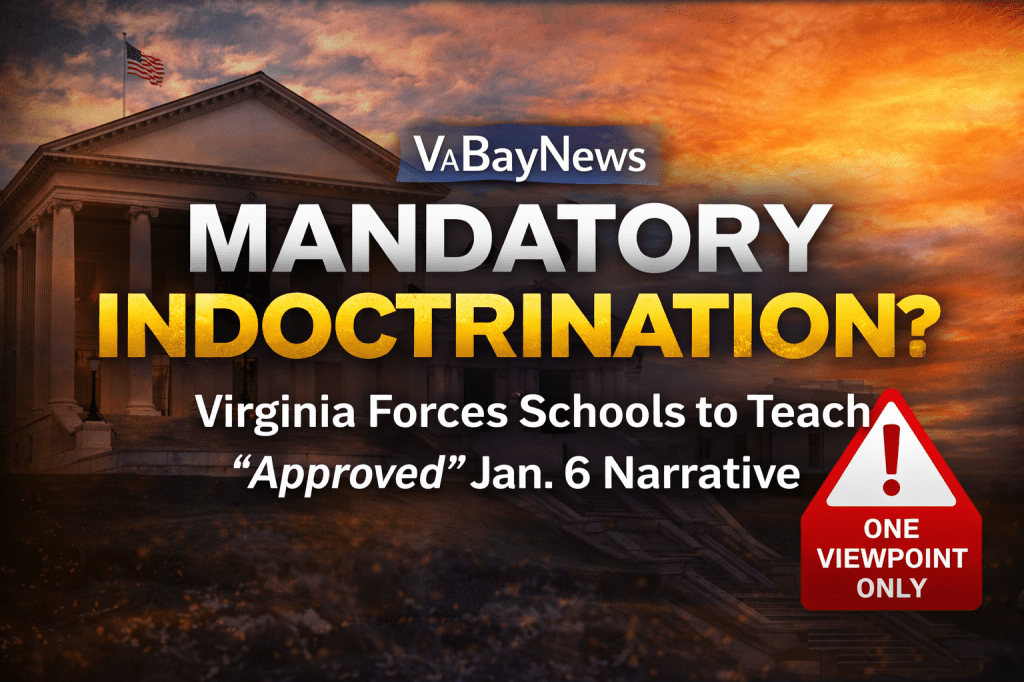
In the Virginia General Assembly’s latest push into the classroom, Democrats have advanced legislation that critics say would mandate a single, government-approved interpretation of the events of January 6, 2021 while barring teachers from presenting alternative perspectives or controversial claims surrounding the 2020 election.
The legislation, House Bill 333, recently passed the General Assembly and now heads to the desk of newly elected Governor Abigail Spanberger, who campaigned as a centrist promising unity and pragmatic governance.
If signed, the bill would require that any instruction about January 6 must describe it as “an unprecedented, violent attack on democracy to overturn the 2020 election results.”
The legislation goes further: educators would be prohibited from portraying the event as a peaceful protest or from presenting claims of election fraud in the 2020 presidential election as credible within curriculum materials or classroom discussion.
Supporters say the measure is intended to prevent misinformation from entering classrooms. Critics say it represents something far more troubling: state-mandated political orthodoxy.
From Civic Education to Government Script
For decades, public schools have attempted—however imperfectly—to encourage students to analyze historical events through multiple viewpoints. That principle appears to be under pressure in Richmond.
Under HB 333, teachers would effectively be required to adhere to a single narrative framework approved by the state government when discussing January 6.
In practical terms, that means:
- Teachers must describe the event using the bill’s prescribed language.
- Educators may not frame the event as a peaceful protest.
- Claims about election irregularities or fraud cannot be presented as credible viewpoints.
Critics argue the law does not merely set curriculum standards—it polices discussion itself.
In other words, a history teacher who allows students to debate competing interpretations of the event could risk violating state law.
That prospect alarms civil libertarians across the political spectrum.
A Moderate Governor Faces an Early Test
The bill now places Governor Spanberger in a difficult political position.
Spanberger, a former CIA officer who won the governorship presenting herself as a pragmatic moderate capable of bridging partisan divides, now faces a decision that could define her administration’s approach to education and free expression.
Her campaign message emphasized unity, civility, and restoring trust in government.
Signing HB 333 could leave critics asking whether that promise applies to ideological diversity in the classroom.
Opponents argue the measure contradicts the spirit of open inquiry that public education should promote.
“If students are only allowed to hear the government’s approved explanation of events,” one Virginia education policy analyst said, “that isn’t civic education. That’s messaging.”
The Slippery Slope of Narrative Laws
Supporters of the bill argue that the facts surrounding January 6 are well established and that schools have a responsibility to prevent the spread of conspiracy theories.
But critics warn that allowing the government to dictate historical interpretation sets a dangerous precedent.
History is rarely static.
Scholars regularly revise interpretations as new evidence emerges, and classroom discussions often explore controversial or disputed claims precisely to teach students how to evaluate information critically.
Once government begins defining which interpretations are acceptable and which are forbidden, critics argue, the line between education and political messaging becomes dangerously thin.
Today the topic is January 6.
Tomorrow it could be something else.
Virginia’s Long Tradition of Debate
Virginia has historically prided itself on being a place where ideas—especially political ones—are debated vigorously.
From the founding era to modern times, the Commonwealth has been home to some of the country’s most consequential arguments about democracy, federal power, and civil liberty.
Critics say HB 333 moves the state in the opposite direction.
Rather than encouraging debate, they argue, the legislation codifies a single political interpretation into law.
That approach, opponents warn, risks turning classrooms into echo chambers rather than places of inquiry.
Parents Are Watching
Education policy has increasingly become one of the most volatile issues in American politics, and Virginia has been at the center of that debate in recent years.
From school curriculum controversies to parental rights disputes, voters have repeatedly signaled that what happens inside the classroom matters deeply to them.
For many parents, the concern isn’t about defending conspiracy theories.
It’s about ensuring that schools teach students how to think, not what to think.
Whether Governor Spanberger signs or vetoes HB 333 may determine how those parents view her administration moving forward.
The Larger Question
The debate over HB 333 ultimately raises a broader question about the role of government in shaping historical memory.
Should the state determine the official interpretation of recent political events?
Or should classrooms remain places where competing viewpoints can be examined, debated, and challenged?
Virginia lawmakers appear to have made their choice.
Now the decision rests with the governor.
And with it comes a defining test: whether the Commonwealth will remain a place of open debate—or move toward government-approved history lessons.
Support Independent Journalism
Virginia Bay News is part of the Bay News Media Network — a growing group of independent, reader-supported newsrooms covering government accountability, courts, public safety, and institutional failures across the country.
Support independent journalism that isn’t funded by political parties, corporations, or government agencies
Submit tips or documents securely — if you see something wrong, we want to know
Independent reporting only works when readers stay engaged. Your attention, tips, and support help keep these stories alive.
 Virginia Bay News