
The Unanswered Questions in the Killing of Donovon Lynch

By Michael Phillips | VABayNews | Thunder Report
On the night of March 26, 2021, the Virginia Beach Oceanfront turned into a chaotic urban battlefield.
Gunfire erupted in multiple locations.
Crowds fled in panic.
Police officers sprinted toward danger with incomplete information.
Within roughly half an hour, three separate shooting incidents unfolded within a few blocks.
By the end of the night, two innocent people were dead.
One of them was 25-year-old Donovon Lynch, a young business owner and security professional who had been walking back to his car after leaving a nightclub with friends.
Lynch was not a suspect in any crime.
Yet he became the only person shot and killed by police that night.
Officer Solomon Simmons, a Virginia Beach police officer who had already responded to two violent incidents that evening, fired three rounds at Lynch at approximately 11:51 p.m.
Within minutes, Lynch was dead.
In the years since, a special grand jury cleared Simmons of criminal wrongdoing, the City of Virginia Beach paid $3 million in a civil settlement, and the Virginia Beach Independent Citizens Review Board deadlocked in 2026, unable to reach a consensus on whether the police investigation itself had been adequate.
But five years later, fundamental questions about the shooting remain unresolved.
Those questions center not only on what happened in the final seconds before Lynch was shot—but on the psychological and operational state of the officer who pulled the trigger.
Because by the time Simmons encountered Donovon Lynch, he had already experienced one of the most chaotic nights of policing imaginable.
And that raises a critical question:
Was Officer Simmons in a mental state capable of making a sound, controlled decision to use deadly force?
Or was he a traumatized officer operating in pure adrenaline and panic?
A Night of Escalating Chaos
To understand the Lynch shooting, it is necessary to reconstruct the environment that produced it.
The Virginia Beach Oceanfront that night was crowded with visitors enjoying the early spring evening after COVID restrictions had eased.
Police staffing was limited relative to the crowds.
Then, shortly after 11:20 p.m., the first shooting erupted.
Gunfire broke out in the 2000 block of Atlantic Avenue, injuring several people.
Officer Solomon Simmons was one of the first officers to arrive.
According to investigative records, Simmons immediately began rendering aid to a wounded victim, applying pressure to a leg wound while awaiting EMS.
He then briefly followed the ambulance transporting the victim.
At some point, he returned to the Oceanfront area.
By then, the night was spiraling further out of control.
A second major shooting erupted roughly ten minutes later in a parking lot on Pacific Avenue between 19th and 20th Streets.
Witnesses reported dozens of gunshots.
Police vehicles flooded the area.
Crowds scattered in every direction.
In the middle of this chaos, Simmons was driving nearby on 20th Street when he heard the gunfire.
What he did next would become one of the most discussed decisions in the case.
He abandoned his patrol vehicle in the roadway and ran toward the gunfire.
While running, his body camera remained turned off.
That decision—whether intentional or the result of cognitive overload—would later deprive investigators of the most critical evidence in the case.
Within moments, Simmons arrived near the parking lot where the second shooting had occurred.
There he witnessed another shocking moment:
A vehicle struck and injured another police officer.
Sirens blared.
People screamed.
Gunfire echoes still reverberated through the area.
For Simmons, the night had already become a cascade of high-stress events.
But it was about to escalate once more.
The Third Shooting
Approximately three to six minutes after the second shooting ended, Simmons encountered Donovon Lynch.
Lynch and his friend Darrion Marsh had been attempting to return to their car after leaving a nightclub earlier in the evening.
Their vehicle was parked roughly two blocks away.
Normally, the walk would have taken about five minutes.
Instead, it took them nearly thirty minutes.
The reason was obvious: gunfire and chaos had repeatedly forced them to shelter and move cautiously through the Oceanfront streets.
By the time they approached the intersection near Pacific Avenue and 20th Street, they were walking through an area that had just experienced a mass shooting.
Police vehicles were converging on the scene.
People were fleeing.
Moments later, Simmons emerged from the opposite side of the street.
Within seconds, he fired three shots.
Donovon Lynch collapsed.
The Official Narrative
According to Simmons’ account, the shooting was justified because he perceived an immediate threat.
Simmons told investigators that:
- He heard the sound of a handgun being “racked” or “cocked.”
- He saw Lynch holding a firearm.
- Lynch began turning toward him.
Believing Lynch was about to shoot, Simmons fired three rounds.
Police later recovered a 9mm Ruger handgun registered to Lynch, who had a legal concealed carry permit.
A special grand jury concluded Simmons reasonably believed his life—and the lives of others—were in danger.
No charges were filed.
Case closed.
Except it wasn’t.
Because from the very beginning, the facts surrounding the encounter have raised serious questions.
The Witness Who Saw Something Different
The most important witness to the shooting was Darrion Marsh, the man walking beside Lynch.
Marsh’s account sharply contradicts the official narrative.
According to Marsh:
- Lynch never drew a gun
- Simmons never identified himself
- There were no verbal commands
- Simmons emerged suddenly and fired
Marsh later said Lynch, after being shot, asked the officer:
“Why did you shoot me?”
That single question has haunted the case ever since.
The Expert Who Disagreed With the Grand Jury
In 2022, the Lynch family hired Dr. Darrin Porcher, a retired NYPD lieutenant and criminal justice expert, to analyze the shooting.
Porcher’s findings were stark.
According to his analysis:
- Simmons approached Lynch from the rear or side
- Lynch was facing away when the encounter began
- There was no clear visible threat
- Simmons failed to use de-escalation tactics
Porcher concluded that the use of deadly force was excessive.
His findings directly contradicted the grand jury’s conclusions.
The Question of Simmons’ Mental State
But perhaps the most underexamined issue in the case is the psychological condition of Officer Simmons at the time of the shooting.
Within roughly thirty minutes, Simmons had experienced:
- Responding to the first mass shooting
- Providing medical aid to a wounded victim
- Following an ambulance from the scene
- Returning to an active crime area
- Hearing dozens of gunshots from a second shooting
- Abandoning his vehicle and sprinting toward gunfire
- Witnessing a police officer struck by a vehicle
This sequence would overwhelm even seasoned officers.
Police training recognizes that exposure to repeated traumatic events in rapid succession can produce extreme adrenaline responses, cognitive narrowing, and impaired judgment.
In tactical terms, this is sometimes referred to as “threat tunnel vision.”
The brain becomes hyper-focused on danger.
Ambiguous stimuli can be interpreted as lethal threats.
Split-second decisions can become impulsive reactions.
Yet there has never been public disclosure of any independent psychological evaluation of Simmons after the shooting.
Was he suffering from an acute stress response?
Was he operating under adrenaline-induced perceptual distortion?
Why did he abandon the ambulance he was following?
No public record answers those questions.
The Gun That Appeared Later
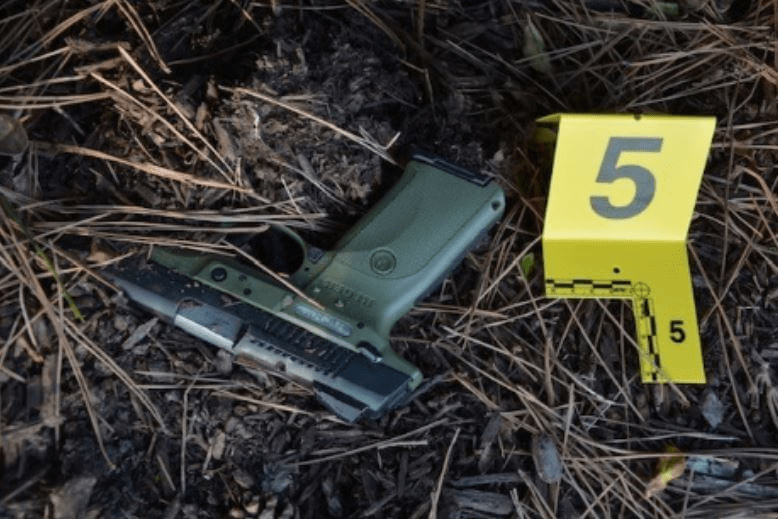
One of the most controversial aspects of the case involves the timeline surrounding the handgun attributed to Lynch.
Initial reports following the shooting made no mention of a gun.
In fact, for several days after the incident, early media coverage described Lynch simply as a bystander shot by police.
The presence of a firearm entered the narrative three days later.
That shift raised immediate questions.
Attorney Jeff Reichert, who represented the Lynch family, has claimed the gun was not initially discovered at the scene.
According to Reichert, the firearm remained in Lynch’s clothing and was not located until much later.
That claim has never been fully reconciled with the official account that police recovered the gun immediately.
The discrepancy matters.
Because if the gun was not immediately secured, it raises critical questions about the integrity of the crime scene.
The Scene That Was Altered
Another controversial detail is that Lynch’s body was moved approximately half a block shortly after the shooting.
City officials said the move was necessary to render medical aid in a safer location. Not to stage the crime scene.
Critics argue that moving the body before full forensic documentation risks disturbing evidence.
The movement also raises a simple question:
If officers believed Lynch had a gun, why was that weapon not immediately secured before the body was moved?
Standard policing protocols generally prioritize securing firearms in volatile scenes.
Yet photographs later released by police show the handgun lying in the grass near bushes, rather than secured as evidence.
How long was the gun there?
Who placed it there?
Those questions remain unresolved.
The Sound That Simmons Claimed to Hear
Simmons’ account hinges on a specific sensory detail.
He said he heard the sound of Lynch racking a handgun slide.
But that claim raises its own set of problems.
At the time Simmons claims to have heard the sound:
- Crowds were screaming
- Sirens were blaring
- Officers were shouting
- Dozens of gunshots had recently been fired
In such an environment, identifying a brief metallic sound would be extremely difficult unless the officer was standing very close to the source.
Yet the official narrative also suggests Simmons approached Lynch from a distance after hearing the sound.
Those two elements are difficult to reconcile.
The Geometry Problem
Another major question involves the physical positioning of the encounter.
Simmons was reportedly running toward the second shooting scene.
Lynch and Marsh were walking away from the chaos toward their parked car.
If Simmons was running toward the gunfire, how did he suddenly encounter Lynch on the opposite side of the street?
Did Simmons change direction?
Did he pivot unexpectedly?
Or did the encounter occur in a completely different orientation than described in official summaries?
Because if Lynch was facing away from Simmons, as some analyses suggest, the officer would have been approaching from behind.
In that scenario, Lynch would have had no opportunity to react to Simmons’ presence before being shot. Simmons would not have been able to see a firearm in Lynch’s hands.
The Phone That Was Never Addressed
Another unresolved detail is the location of Lynch’s phone.
In chaotic nighttime scenes, phones can easily be mistaken for weapons.
Police shootings involving mistaken identification of phones have occurred numerous times in the United States.
Yet there has been little public discussion of whether Lynch was holding a phone or other object when Simmons approached.
The possibility has never been fully investigated in public.
The Timeline That Doesn’t Add Up
Perhaps the most troubling aspect of the case is the timeline itself.
The second shooting reportedly ended minutes before the encounter with Lynch.
By that point:
- Numerous officers were already converging on the area
- Emergency lights were flashing
- Police commands were being shouted
Why would Lynch suddenly pull a gun in the middle of a heavily policed crime scene?
Why would someone with a concealed carry permit draw a weapon directly in front of responding officers?
The scenario seems counterintuitive.
And that contradiction lies at the heart of the case.
A Night That Changed Two Lives
Officer Simmons returned home alive that night.
Donovon Lynch did not.
Lynch was pronounced dead at approximately 12:07 a.m.
His death was ruled a homicide.
The city later settled with the Lynch family for $3 million, though officials admitted no wrongdoing.
For the Lynch family, the settlement was never the point.
They have spent years demanding something else.
Answers.
The Questions That Remain
Five years later, key questions remain unanswered:
- Why was Simmons’ body camera not activated?
- Was Simmons psychologically evaluated after the shooting?
- When exactly was Lynch’s firearm discovered?
- Why was Lynch’s body moved before full forensic documentation?
- Why were witnesses’ accounts contradicting the police narrative not fully reconciled?
- How could Simmons hear a gun being racked in the middle of extreme chaos?
- If Lynch was facing away, how could he have pointed a weapon at Simmons?
- Why did early reports omit mention of a gun?
Perhaps the most haunting question remains the simplest one.
Was this a justified use of force?
Or was it a tragic collision between a frightened officer and an innocent man caught in the wrong place at the worst possible moment?
A Story Still Unfinished
The Virginia Beach Oceanfront shootings were chaotic.
No one disputes that.
Police officers were responding to multiple violent incidents within minutes.
But chaos does not eliminate the need for clarity.
And the killing of Donovon Lynch remains a case defined by ambiguity.
In February 2026, the Virginia Beach Independent Citizens Review Board reviewed the police investigation into the shooting.
The board deadlocked.
No findings.
No conclusions.
No closure.
Which means the central question of that night remains unresolved.
What really happened in those final seconds before Officer Solomon Simmons pulled the trigger?
And was the decision made by a calm officer assessing a threat…
or by a traumatized officer reacting to a night of fear?
Until those questions are answered, the story of Donovon Lynch is not over.
Support Independent Journalism
Virginia Bay News is part of the Bay News Media Network — a growing group of independent, reader-supported newsrooms covering government accountability, courts, public safety, and institutional failures across the country.
Support independent journalism that isn’t funded by political parties, corporations, or government agencies
Submit tips or documents securely — if you see something wrong, we want to know
Independent reporting only works when readers stay engaged. Your attention, tips, and support help keep these stories alive.
 Virginia Bay News