
By VA Bay News Staff
A bill moving through the Virginia General Assembly is raising serious questions about equal protection, prosecutorial discretion, and whether criminal law should be rewritten to single out specific religious groups for special treatment.
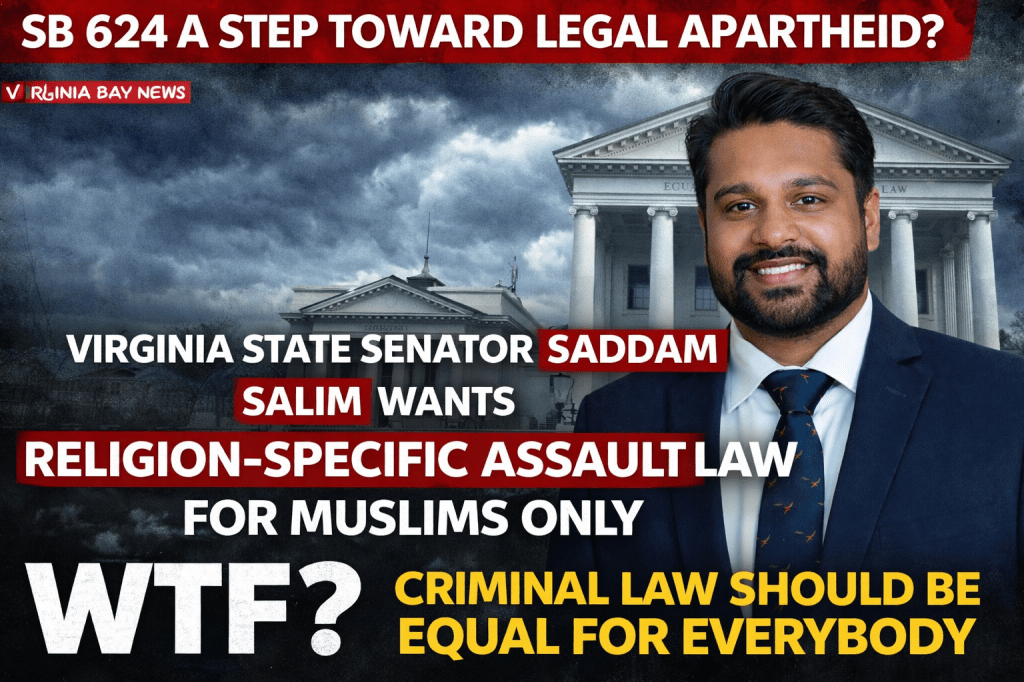
SB 624, sponsored by Saddam Salim, would create a statutory definition of “Islamophobia” tied specifically to the crimes of assault and battery. Under the bill, an assault motivated by “malicious prejudice or hatred directed toward Islam or Muslims” would be treated differently in law and reporting than other assaults—regardless of whether the victim is actually Muslim, so long as the attacker perceived them to be.
At first glance, the stated intent sounds reasonable: no one should be assaulted because of their faith. But that principle is already well-established in Virginia law.
What the Law Already Covers
Virginia already criminalizes assault and battery. It already enhances penalties for hate crimes. And it already protects people from violence motivated by religion, race, ethnicity, or other protected characteristics.
Those laws apply equally—to Muslims, Christians, Jews, Sikhs, atheists, and everyone else.
That raises a fundamental question: what problem is SB 624 actually solving?
Creating a Parallel Standard
Rather than strengthening enforcement of existing hate-crime statutes, SB 624 carves out a religion-specific definition and embeds it directly into criminal law. That creates a parallel framework—one religious group, one statutory label, one reporting pipeline.
The concern isn’t about protecting Muslims. The concern is about fragmenting criminal law into identity-based silos, where offenses are categorized not by conduct, but by which group the legislature chooses to spotlight.
Once that door opens, it becomes hard to close.
If Islamophobia merits a stand-alone statutory definition tied to assault, what about antisemitism? Anti-Christian hostility? Anti-Sikh violence? Each has tragically occurred. Each could demand its own bill. The result is not equal justice, but a patchwork of symbolic statutes driven more by politics than by principle.
Perception-Based Criminal Motive
SB 624 also hinges on perceived religious identity. That is a slippery standard in criminal law, where intent and motive already require careful proof.
Under this bill, the victim’s actual beliefs are irrelevant; what matters is what the accused allegedly believed about them. That raises due-process concerns and expands prosecutorial discretion in ways that may be difficult to apply consistently or fairly.
Criminal law should be precise, not performative.
Reporting vs. Enforcement
The bill also directs the Department of State Police, in consultation with the Attorney General and the Office of Diversity, Equity, and Inclusion, to incorporate this new definition into hate-crime reporting systems.
Data collection matters. But data definitions are not a substitute for enforcement.
If assaults motivated by religious hatred are underreported or under-prosecuted, the solution is to enforce the law already on the books—not to redefine crimes based on which advocacy group has the legislature’s ear.
Equal Protection Should Mean Equal
The American legal system is built on a simple idea: the law protects everyone equally, and crimes are punished based on actions—not identities.
When lawmakers begin writing criminal statutes that name specific religions for special treatment, even with good intentions, they undermine that principle.
Virginia does not need religion-specific assault laws. It needs consistent enforcement, neutral standards, and equal protection under the law—for everyone.
SB 624 risks trading those fundamentals for symbolism. And symbolism is a poor foundation for criminal justice.
Support Independent Journalism
Virginia Bay News is part of the Bay News Media Network — a growing group of independent, reader-supported newsrooms covering government accountability, courts, public safety, and institutional failures across the country.
Support independent journalism that isn’t funded by political parties, corporations, or government agencies
Submit tips or documents securely — if you see something wrong, we want to know
Independent reporting only works when readers stay engaged. Your attention, tips, and support help keep these stories alive.
 Virginia Bay News