
By VABayNews Staff
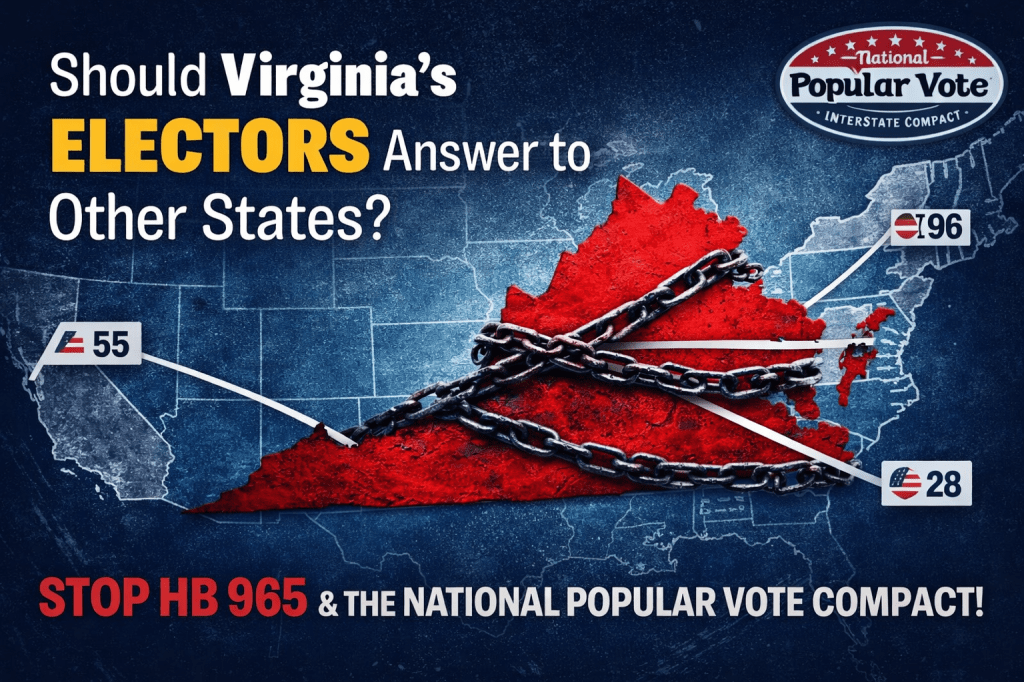
Virginia lawmakers are once again weighing whether to join the National Popular Vote Interstate Compact through HB 965—a proposal that would fundamentally change how the Commonwealth allocates its presidential electors. Supporters frame the measure as a democratic reform. Critics see something far more consequential: the surrender of Virginia voters’ decision-making power to outcomes determined elsewhere.
At the heart of the debate is a simple but unsettling reality. Under the compact, Virginia would be obligated to award all of its presidential electoral votes to the candidate who wins the national popular vote—even if that candidate loses decisively within Virginia itself.
When Virginia Votes Don’t Decide Virginia’s Electors
Consider a plausible scenario. Virginia voters favor Candidate A by a clear margin. Historically, that result would determine how the Commonwealth’s electors are awarded. Under the compact, however, that outcome could be overridden if Candidate B amasses a larger national vote total, driven by turnout in a handful of high-population states.
In that case, Virginians would vote, tally the results, and then watch their state’s electoral votes be redirected to a candidate they rejected.
That is not a hypothetical edge case. It is the core mechanism of the compact.
Federalism vs. Population Gravity
The U.S. Constitution deliberately balances population with state sovereignty through the Electoral College. States are not administrative districts of a national plebiscite; they are distinct political communities with their own interests, economies, and voters.
HB 965 would tilt that balance sharply toward population gravity, concentrating political influence in a small number of urban megastates. Campaigns would have fewer incentives to engage with Virginia-specific concerns—military communities, rural infrastructure, ports, energy corridors—if winning California, New York, or Illinois becomes the dominant path to victory.
That shift is not abstract. It alters campaign strategy, policy priorities, and whose voices matter.
The Consent Problem
Perhaps the most serious concern is consent. Virginians currently understand the rules of presidential elections: vote statewide, winner receives the state’s electors. HB 965 changes that social contract without asking voters directly.
If the Commonwealth is prepared to abandon state-based elector allocation, that decision should come through a constitutional amendment or a statewide referendum—not through an interstate workaround adopted by a simple legislative majority.
Anything less risks eroding public trust in elections at a time when confidence is already fragile.
Slippery Reform, Permanent Consequences
Proponents argue the compact prevents “wrong-winner” elections. Critics counter that it replaces one perceived flaw with a deeper democratic tension: votes cast in Virginia becoming functionally advisory, not determinative.
Once implemented, the compact is difficult to unwind—especially if enough states join to activate it nationally. Virginia would be locking itself into a system where future presidential outcomes are increasingly shaped elsewhere, regardless of how its own citizens vote.
The Question Lawmakers Must Answer
HB 965 is not merely a procedural tweak. It is a redefinition of representation.
Before Virginia hands off its electoral authority to a national aggregate, lawmakers owe voters a clear answer to a basic question:
Should Virginians decide how Virginia’s presidential electors are awarded—or should that decision be made by voters in other states?
That is the debate HB 965 demands. And it deserves far more scrutiny than it has received so far.
Support Independent Journalism
Virginia Bay News is part of the Bay News Media Network — a growing group of independent, reader-supported newsrooms covering government accountability, courts, public safety, and institutional failures across the country.
Support independent journalism that isn’t funded by political parties, corporations, or government agencies
Submit tips or documents securely — if you see something wrong, we want to know
Independent reporting only works when readers stay engaged. Your attention, tips, and support help keep these stories alive.
 Virginia Bay News